ISO Certifications in Riyadh | Audit And Compliance Experts
شهادات الأيزو في الرياض مع دعم شامل للتدقيق والامتثال وفق المعايير الدولية.
نساعد الشركات على تحقيق الاعتماد وتعزيز الكفاءة التشغيلية بثقة واحترافية.
ISO certification in Riyadh is a structured third-party conformity process that helps businesses demonstrate compliance with international management standards for quality, safety, environment, information security, and operational control. It is widely used by companies seeking tender eligibility, client trust, and stronger internal systems.
What Is ISO Certification In Riyadh?
ISO certification implies that your business is complying with international standards on quality, safety, or management. ISO is an abbreviation for International Organization for Standardization. It is a worldwide organization that sets standards for all businesses across the globe.
When your business is ISO certified, your work is audited by an independent party. The party will then ensure that your business meets the standard required. Upon passing, your business is then issued with an ISO certificate.
Riyadh has become one of the most compliance-driven business centres in the Kingdom because many organizations here operate under direct client scrutiny, government contract requirements, multinational supply expectations, and strict sector-specific controls. For many companies, ISO certification is no longer treated as a branding exercise; it is increasingly linked to operational credibility, supplier qualification, and structured governance.
In practical project environments across Riyadh, certification often starts when a company faces a tender requirement, a client audit, a regional expansion plan, or repeated operational inconsistencies that management wants to control. Construction firms often need stronger documentation discipline, healthcare providers require traceability, IT companies must demonstrate information security maturity, and manufacturing businesses are expected to show controlled production systems. The local market also creates pressure through procurement filters. Government-linked buyers, oil and gas contractors, major developers, logistics operators, and large service groups frequently request evidence of certified systems before onboarding vendors.
Why is ISO Certification Important In Riyadh?
ISO certification is essential because it implies to your customers that your business is reliable, well-organized, and professional. Many government projects and large business entities in Saudi Arabia only deal with ISO-certified business entities.
How does ISO Certification work?
The process begins by selecting the appropriate ISO standard that your business requires. A consultant is then hired to assist with preparing your business documents. The auditor then comes to audit your business.
Key reasons why ISO certification is popular in Riyadh:
- Builds Customer Trust: Shows commitment to quality and consistent service
- Improves Business Credibility: Enhances brand image in a competitive market
- Required for Tenders: Essential for government and large corporate projects
- Boosts Operational Efficiency: Reduces errors and improves processes
- Ensures Legal Compliance: Helps meet local and international regulations
- Increases Market Opportunities: Opens doors to global business expansion
- Risk Management: Identifies and controls potential business risks
- Employee Awareness: Improves workplace safety and responsibility
Why ISO Certification Is the Most Popular in Riyadh
ISO Certification in Riyadh, has become a necessary requirement for organizations to Grow, Compete and meet international standards. To improve quality & ensure compliance, companies in all industries are adopting ISO standards which help organizations to gain market credibility. They have now issued certifications according to frameworks developed by the International Organization for Standardization, promoting global acceptance and equivalence.
- Alignment with Vision 2030: The Saudi Vision 2030 plan is urging businesses to apply international standards in order to facilitate transparency, efficiency and increase economic growth.
- Tender & Contract Eligibility: For government and large corporate projects, ISO certification is a common requirement, thus it becomes critical for any business looking to win high-value contracts.
- Customer Confidence: ISO certification indicates a structured approach to processes and deliverables, leading to consistent quality of outcome in TAT adherence and other metrics, thereby instilling client confidence and trust across the ecosystem.
- Operational Efficiency: ISO standards provide organizations with clear systems and controls that can help them streamline processes, reduce errors, and improve overall productivity.
- Regulatory Compliance: ISO certification shows that businesses comply with local as well as international standards, which can lower legal liabilities and increase accountability.
- International Recognition: ISO-certified companies in Riyadh gain easier access to GCC and global markets, as the certification is recognized worldwide.
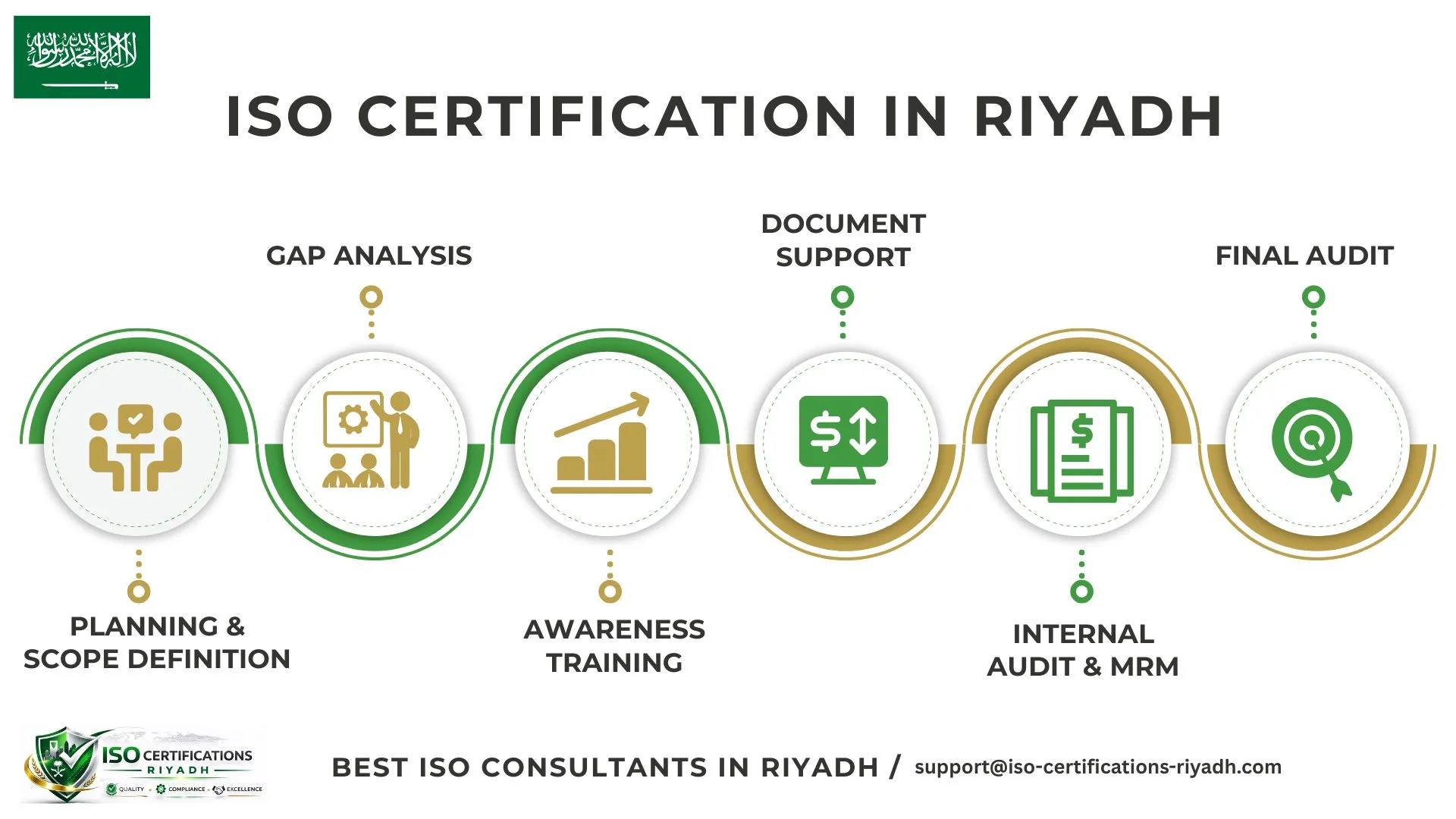
How To Get ISO Certification In Riyadh- 6 Simple Steps
Popular ISO Standards Adopted by Businesses in Riyadh
ISO 9001 – Quality Management (QMS)
Objective: Improve quality and customer satisfaction. Helps streamline processes, reduce errors, and ensure consistent delivery.
ISO 14001 – Environmental (EMS)
Objective: Manage environmental impact. Reduces waste, controls pollution, and improves eco-friendly brand image.
ISO 45001 – Health & Safety
Objective: Ensure workplace safety. Helps prevent accidents and improve safety systems.
ISO 27001 – Information Security
Objective: Protect data and manage cyber risks. Builds trust and confidentiality.
ISO 22000 – Food Safety
Objective: Ensure hygiene and food safety across the supply chain.
ISO 13485 – Medical Devices
Objective: Ensure quality and compliance for medical products globally.
ISO 53001 – Asset Management
Objective: Improve asset performance and reduce operational costs.
ISO 42001 – AI Management
Objective: Ensure ethical and transparent AI system usage.
CE Mark Certification
Objective: Meet EU standards and sell products in European markets.
Halal Certification
Objective: Ensure compliance with Islamic standards and expand global market reach.
ISO Certification Process In Riyadh (2026)
- Consultation & Gap Analysis: The first stage usually starts with reviewing how the business currently operates against the selected standard rather than immediately writing documents. In Riyadh projects, this often reveals that departments already perform many activities informally but cannot demonstrate consistency. A proper gap analysis identifies missing controls, weak approvals, absent records, and unclear ownership. Common delays happen when leadership assumes documentation already exists but operational evidence is incomplete.
- Documentation Development: Documentation must reflect actual working practice, not copied templates. Auditors quickly detect generic manuals that do not match operational reality. This stage usually includes policies, procedures, registers, forms, risk controls, and role responsibilities. Delays occur when departments do not agree on approval flows or process ownership.
- Implementation & Team Training: Implementation is where many projects slow down because documents must become daily working controls. Staff need to understand approvals, records, escalation methods, and evidence generation. Training is critical because many audit findings occur when employees cannot explain their own process responsibilities during interviews. Consultants usually monitor early implementation closely to ensure forms are being used correctly and corrective actions are recorded properly.
- Internal Audit & Readiness Review: Internal audit checks whether the system works before the certification body arrives. This stage often reveals practical gaps such as incomplete records, weak follow-up, or missing management review evidence. In Riyadh organizations, readiness reviews frequently identify departments that implemented unevenly despite approved procedures.
- Certification Audit Support: Certification bodies conduct stage audits independently, but consultant support helps management respond correctly to audit trails and findings. Common delays happen when records are scattered across departments or key personnel are unavailable during audit interviews. Experienced support helps organizations explain controls clearly, close minor findings correctly, and maintain confidence during auditor sampling.
How Long Does ISO Certification Take in Riyadh?
For most organizations, realistic certification preparation takes between 8 and 16 weeks when management involvement is active and operational records are available early.
Smaller service companies may move faster because process complexity is lower. Industrial operations, healthcare environments, and multi-location businesses usually require more time because evidence must build gradually before audit readiness.
The most common delays come from late document approvals, weak record discipline, incomplete risk reviews, and internal audit postponements.
Fast-track projects are possible when strong systems already exist internally, but certification timing still depends on audit body scheduling and readiness quality rather than paperwork alone.
Cost Of ISO Certification In Riyadh
Certification cost in Riyadh depends mainly on business size, number of employees, number of locations, selected standard, operational complexity, and audit duration required by the certification body.
A company with one office and limited scope usually requires fewer audit days than a multi-site business with manufacturing, field teams, or regulated activities. Integrated systems such as ISO 9001, ISO 14001, and ISO 45001 together may reduce duplication but still require deeper preparation.
Certification body charges are separate from implementation support. Audit cost is influenced by accreditation level, audit days, sector category, and travel requirements where multiple locations are involved.
Complexity increases where bilingual systems, legal registers, subcontractor controls, technical validations, or regulated production environments exist. The most realistic cost estimate comes only after scope review.
Ready to Get ISO Certified in Riyadh?
Build a stronger, compliant, and internationally trusted business with ShineCert. Our experts guide you from consultation and implementation to certification.
Start Your ISO Certification in Riyadh Today
Get expert guidance, fast approval, and internationally recognized ISO certification for your business in Saudi Arabia.
FAQs
Is ISO certification mandatory in Riyadh?
ISO certification is generally voluntary unless required by a contract, tender, client specification, or sector-specific procurement condition. In many Riyadh industries, certification becomes commercially necessary because buyers use it as a qualification filter.
Who issues the ISO certificate?
The certificate is issued by an independent certification body after successful audit completion. Consultants prepare the system, but only accredited certification bodies can issue valid certificates.
Is ISO certification internationally valid?
Yes, when issued by a recognized accredited certification body, the certificate is internationally accepted and usually recognized across supply chains and procurement systems.
How long is an ISO certificate valid?
Most certificates remain valid for three years, with annual surveillance audits to confirm continued compliance and effective system maintenance.
Can SMEs apply for ISO certification?
Yes, small and medium-sized businesses can implement ISO standards. The system is scaled according to business size, process complexity, and operational risk.
Can one company implement multiple ISO standards together?
Yes, integrated systems are common, especially combining quality, environment, and occupational safety because many controls overlap.