
ISO Certification in Yanbu, Saudi Arabia
ISO Consulting, Implementation and Certification Support Services for Industrial, Export, Logistics, Refining and Energy Sector Organizations
ISO Certification in Yanbu helps organizations improve business performance, enhance operational efficiency, and demonstrate compliance with internationally recognized management system standards. As a major industrial and port city in Saudi Arabia, Yanbu is home to organizations operating in petrochemicals, oil and gas, manufacturing, logistics, construction, healthcare, food processing, and engineering sectors. ISO certification provides a structured framework for managing quality, environmental responsibilities, occupational health and safety, information security, food safety, and other critical business processes. Popular standards include ISO 9001 for Quality Management, ISO 14001 for Environmental Management, ISO 45001 for Occupational Health and Safety, ISO 27001 for Information Security, and ISO 22000 for Food Safety Management. The certification process typically involves gap analysis, documentation development, system implementation, employee training, internal audits, and certification audits. Achieving ISO certification helps businesses in Yanbu strengthen customer confidence, improve compliance, reduce operational risks, and gain a competitive advantage while supporting sustainable growth and long-term business success.
What is ISO Certification?
ISO certification demonstrates that an organization has implemented a management system that complies with internationally recognized standards developed by the International Organization for Standardization (ISO). These standards provide a structured framework for improving operational efficiency, managing risks, enhancing customer satisfaction, and supporting continual improvement. ISO certification is applicable to organizations of all sizes and industries, including manufacturing, construction, healthcare, logistics, technology, and professional services. Depending on business objectives, organizations may implement standards such as ISO 9001 for Quality Management, ISO 14001 for Environmental Management, ISO 45001 for Occupational Health and Safety, or ISO 27001 for Information Security. Achieving ISO certification helps businesses improve credibility, strengthen stakeholder confidence, ensure compliance with regulatory requirements, and gain a competitive advantage. It demonstrates a commitment to quality, consistency, and long-term business excellence.
Why ISO Certification is Important for Businesses in Yanbu
Supporting Growth in a Global Trade and Industrial Environment
Yanbu’s business ecosystem differs significantly from many other cities within Saudi Arabia.
Organizations frequently serve:
- International customers
- Export markets
- Industrial clients
- Global supply chains
- Engineering projects
- Energy-sector operations
- Logistics networks
- Maritime customers
These business environments demand:
- Reliable operations
- Consistent quality
- Strong safety performance
- Environmental responsibility
- Effective risk management
- Information security
- Business continuity
- Regulatory compliance
A disruption affecting operations, quality, safety, logistics, or customer commitments can have significant financial and reputational consequences.
ISO standards help organizations establish systems capable of managing these challenges while supporting long-term business objectives.
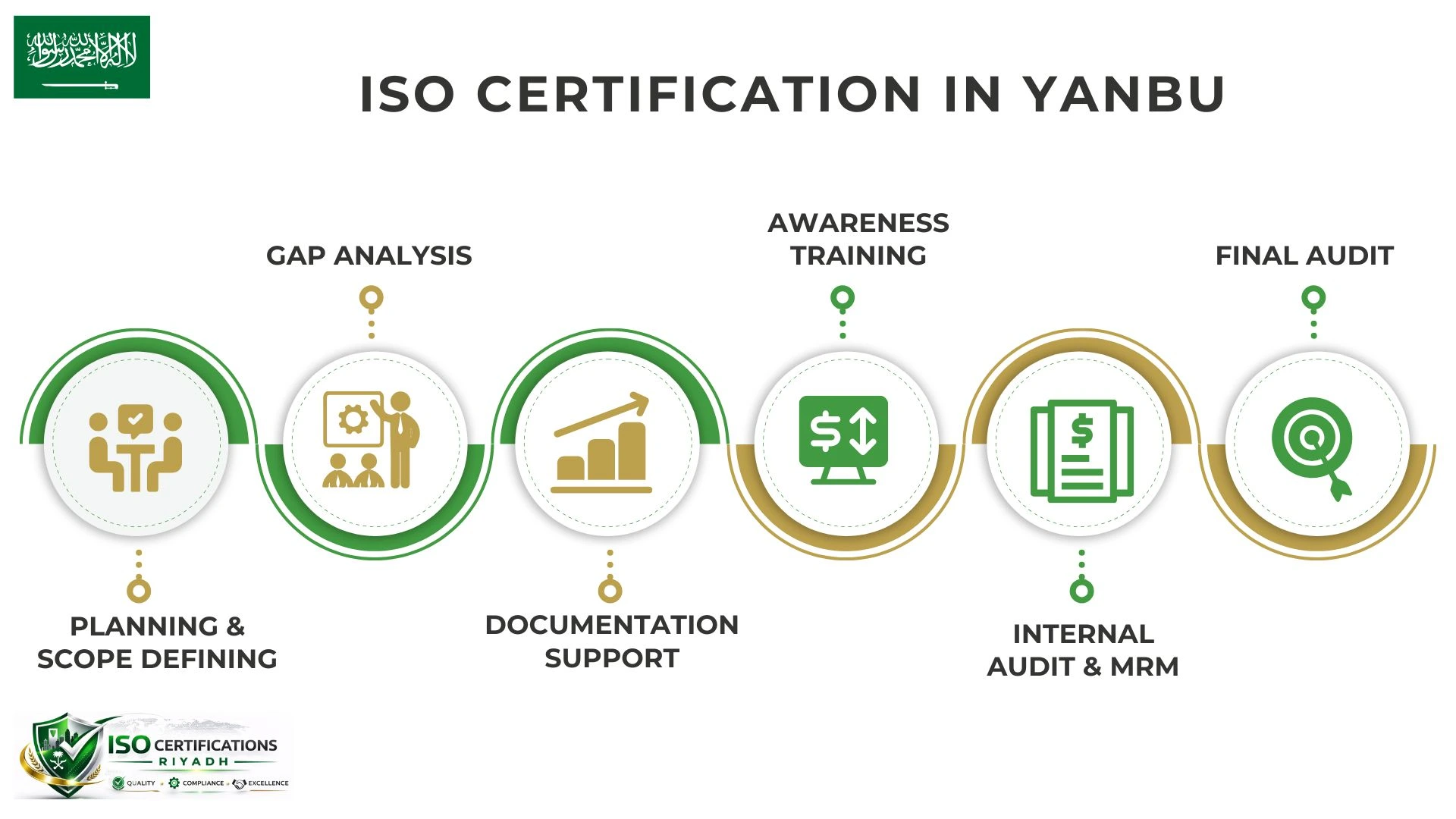
How To Get ISO Certification in Yanbu - 6 Simple Steps
ISO Certification Services We Provide in Yanbu
ISO 9001 – Quality Management (QMS)
Objective: Improve quality, customer satisfaction, and operational efficiency through standardized processes.
ISO 14001 – Environmental Management (EMS)
Objective: Reduce environmental impact, control waste, and support sustainable business practices.
ISO 45001 – Occupational Health & Safety
Objective: Create a safer workplace, prevent accidents, and improve employee well-being.
ISO 27001 – Information Security Management
Objective: Protect sensitive information, reduce cyber risks, and improve data security.
ISO 22000 – Food Safety Management
Objective: Ensure food safety and hygiene throughout the food supply chain.
ISO 13485 – Medical Devices Quality Management
Objective: Ensure consistent quality and regulatory compliance for medical devices.
ISO 55001 – Asset Management
Objective: Improve asset performance, optimize maintenance, and reduce operational costs.
ISO 42001 – Artificial Intelligence Management
Objective: Establish responsible, ethical, and transparent AI governance frameworks.
ISO 50001 – Energy Management
Objective: Improve energy performance, reduce consumption, and lower operating expenses.
ISO 22301 – Business Continuity Management
Objective: Strengthen resilience and ensure business continuity during disruptions.
ISO 20000-1 – IT Service Management
Objective: Improve IT service quality, reliability, and customer satisfaction.
ISO 37001 – Anti-Bribery Management
Objective: Prevent corruption risks and demonstrate ethical business practices.
ISO 31000 – Risk Management
Objective: Identify, assess, and mitigate organizational risks effectively.
ISO 41001 – Facility Management
Objective: Enhance facility performance and improve workplace efficiency.
ISO 29001 – Oil & Gas Quality Management
Objective: Improve quality and reliability in petroleum, petrochemical, and gas industries.
ISO 28000 – Supply Chain Security Management
Objective: Enhance supply chain security and reduce logistics risks.
ISO 17025 – Testing & Calibration Laboratories
Objective: Demonstrate laboratory competence and ensure reliable testing results.
ISO 21001 – Educational Organizations Management
Objective: Improve educational services and learner satisfaction.
ISO 39001 – Road Traffic Safety Management
Objective: Reduce road traffic incidents and improve transportation safety.
CE Mark Certification
Objective: Demonstrate compliance with European regulations and access EU markets.
Halal Certification
Objective: Verify compliance with Halal requirements and expand market opportunities.
GMP Certification
Objective: Ensure products are consistently manufactured according to quality standards.
HACCP Certification
Objective: Identify food safety hazards and establish preventive control measures.
GDP Certification
Objective: Ensure proper storage, handling, and distribution of pharmaceutical products.
Our Practical ISO Implementation Approach
- Initial Assessment, Gap Analysis & Business Understanding: Every implementation project begins with understanding the organization's business model, operational structure, customer expectations, regulatory obligations, and existing management practices. We evaluate current processes, documentation, operational controls, and performance monitoring activities against the requirements of the applicable ISO standard. This assessment helps identify gaps, strengths, weaknesses, and improvement opportunities. The outcome is a practical implementation roadmap aligned with business objectives and operational realities.
- Risk Assessment, Context Analysis & Strategic Planning: Following the gap analysis, we evaluate internal and external issues, interested parties, operational risks, business objectives, and compliance obligations that may influence management system effectiveness. This stage helps organizations adopt risk-based thinking while ensuring that implementation activities support actual business challenges. A structured implementation plan is developed to guide the project effectively.
- Documentation Development & Operational Control Design: Based on identified requirements, practical management system documentation and operational controls are developed. This may include policies, procedures, risk registers, objectives, work instructions, monitoring mechanisms, emergency response plans, and supporting records. Our focus is always on usability and operational effectiveness rather than creating unnecessary documentation.
- System Implementation, Operational Integration & Employee Awareness: Once the framework has been developed, the management system is integrated into daily business operations. Employees are trained on their responsibilities, operational controls are implemented, and awareness activities are conducted across relevant departments. This stage ensures that the management system becomes part of routine business activities rather than remaining a documentation exercise.
- Performance Evaluation, Internal Audit & Management Review: After implementation, internal audits are conducted to verify compliance, assess effectiveness, identify gaps, and evaluate improvement opportunities. Management reviews provide leadership with visibility into performance, risks, objectives, and resource requirements.
- Certification Audit & Continual Improvement: Once the organization is ready, certification audits are conducted by accredited certification bodies. Any identified findings are addressed through corrective actions and continual improvement initiatives. Organizations that achieve the greatest value from ISO certification continue monitoring performance, improving processes, reducing risks, and strengthening operational maturity long after certification is achieved.
Benefits of ISO Certification for Organizations in Yanbu
- Improved Operational Consistency: ISO standards help organizations establish defined processes, clear responsibilities, measurable objectives, and performance monitoring activities. This improves consistency across departments, projects, facilities, and operational functions.
- Increased Customer Confidence: Customers increasingly prefer suppliers and service providers that can demonstrate effective management systems and continual improvement capabilities. ISO certification helps strengthen trust and credibility.
- Better Risk Management: Organizations face risks related to operations, supply chains, technology, safety, environmental performance, customer requirements, and business continuity. ISO standards encourage proactive identification and management of these risks.
- Enhanced Market Competitiveness: Certification can strengthen supplier qualification efforts, support tender participation, improve customer evaluations, and enhance market positioning.
- Improved Compliance Readiness: ISO standards help organizations identify and manage legal, regulatory, contractual, and customer requirements more effectively.
- Support for Sustainable Growth: Organizations with structured management systems are often better positioned to scale operations while maintaining performance and control.
Industries We Support in Yanbu
Energy & Oil & Gas
Engineering Services
EPC Contractors
Professional Services
Technology Companies
Research & Innovation
Manufacturing
Infrastructure Development
Cost of ISO Certification in Yanbu
One of the most common questions businesses ask is:
“How much does ISO certification cost in Yanbu?”
There is no single certification cost because implementation requirements vary significantly between organizations.
Factors affecting certification costs include:
- Organization size
- Number of employees
- Number of locations
- Industry sector
- Scope of certification
- Existing management systems
- Operational complexity
- Certification body fees
- Training requirements
- Documentation requirements
For example:
A logistics company operating a single facility may have different implementation requirements than a refinery contractor managing multiple operational sites.
Similarly, an export-oriented manufacturer pursuing ISO 9001 may require a different level of effort compared to an organization implementing ISO 27001 or ISO 29001.
Why Businesses Choose ISO Certifications Riyadh.com ISO Certification in Yanbu?
Organizations choose ISO Certifications Riyadh because we understand the unique business environment of Yanbu.
We recognize that management system requirements differ significantly between:
- Refinery operations
- Petrochemical facilities
- Export-oriented manufacturers
- Port service providers
- Engineering contractors
- Logistics companies
- Industrial suppliers
- Technology organizations
Our consulting approach focuses on helping organizations establish management systems that support operational performance, customer expectations, compliance requirements, and long-term business objectives.
Our services include:
- Gap Analysis
- Documentation Development
- Employee Training
- Internal Audits
- Risk Assessments
- Management Review Support
- Certification Preparation
- Continual Improvement Guidance
Start Your ISO Certification in Riyadh Today
Get expert guidance, fast approval, and internationally recognized ISO certification for your business in Saudi Arabia.
FAQs
What is the most popular ISO certification in Yanbu?
The most commonly implemented certifications include:
- ISO 9001
- ISO 14001
- ISO 45001
- ISO 27001
- ISO 50001
- ISO 29001
The appropriate certification depends on organizational activities, customer expectations, industry requirements, and business objectives.
Which industries benefit most from ISO certification in Yanbu?
Organizations operating in:
- Oil refining
- Petrochemicals
- Industrial manufacturing
- Engineering
- Logistics
- Port operations
- Maritime services
- Energy infrastructure
- Export-oriented manufacturing
often benefit significantly from structured management systems.
How long does ISO certification take?
Implementation timelines depend on organizational size, operational complexity, existing systems, employee involvement, and certification scope.
A small organization may complete implementation relatively quickly, while larger multi-site organizations often require more extensive preparation.
Can multiple ISO standards be implemented together?
Yes.
Many organizations implement Integrated Management Systems (IMS) combining:
- ISO 9001
- ISO 14001
- ISO 45001
Some organizations further integrate:
- ISO 27001
- ISO 50001
- ISO 22301
- ISO 42001
Integration can improve efficiency while reducing duplication.
Which certification is most relevant for refinery and petrochemical companies?
For refinery, petrochemical, and oil & gas supply chain organizations, the most common certifications include:
- ISO 9001
- ISO 14001
- ISO 45001
- ISO 50001
- ISO 29001
- ISO 22301
The final selection depends on customer requirements, operational risks, and business priorities.