
ISO Certification In Dhahran, Saudi Arabia
ISO Consulting, Implementation and Certification Support Services for Energy, Engineering, Technology and Corporate Organizations
ISO Certification in Dhahran helps organizations improve operational efficiency, strengthen quality management systems, enhance customer satisfaction, and meet international compliance requirements. Businesses across industries, including manufacturing, oil and gas, construction, healthcare, logistics, and information technology, pursue ISO certification to demonstrate their commitment to quality, safety, environmental responsibility, and continual improvement. Popular standards include ISO 9001 for Quality Management, ISO 14001 for Environmental Management, ISO 45001 for Occupational Health and Safety, ISO 27001 for Information Security, and ISO 22000 for Food Safety Management. Achieving ISO certification can improve business credibility, support regulatory compliance, increase customer confidence, and create new opportunities in local and international markets. The certification process typically involves gap assessment, documentation, implementation, internal audits, and certification audits conducted by accredited certification bodies. Organizations in Dhahran use ISO standards as a strategic tool to enhance performance, reduce risks, and maintain sustainable business growth in a competitive market environment.
What Is ISO Certification ?
ISO Certification is a formal recognition that an organization follows internationally accepted standards developed by the International Organization for Standardization (ISO). It demonstrates that a company has implemented effective systems, processes, and controls to consistently deliver quality products or services while meeting customer and regulatory requirements. ISO certification is applicable to businesses of all sizes and industries, including manufacturing, healthcare, construction, information technology, education, logistics, and food production.
The certification process typically includes a gap analysis, system implementation, documentation, employee training, internal audits, and an external audit conducted by an accredited certification body. Different ISO standards focus on specific areas, such as ISO 9001 for Quality Management, ISO 14001 for Environmental Management, ISO 45001 for Occupational Health and Safety, and ISO 27001 for Information Security.
Why ISO Certification is Important for Businesses In Dhahran
Dhahran differs significantly from many industrial cities because of its strong concentration of energy-sector leadership, engineering expertise, technology initiatives, research activities, and corporate decision-making functions.
Organizations operating in this environment often manage:
- Strategic projects
- Technical information
- Customer requirements
- Regulatory obligations
- Operational risks
- Technology investments
- Supply chain relationships
- Sustainability objectives
- Workforce development initiatives
As organizations grow, maintaining consistency, accountability, resilience, and stakeholder confidence becomes increasingly important.
ISO certification helps businesses establish management systems capable of supporting these objectives while improving performance and reducing operational risks.
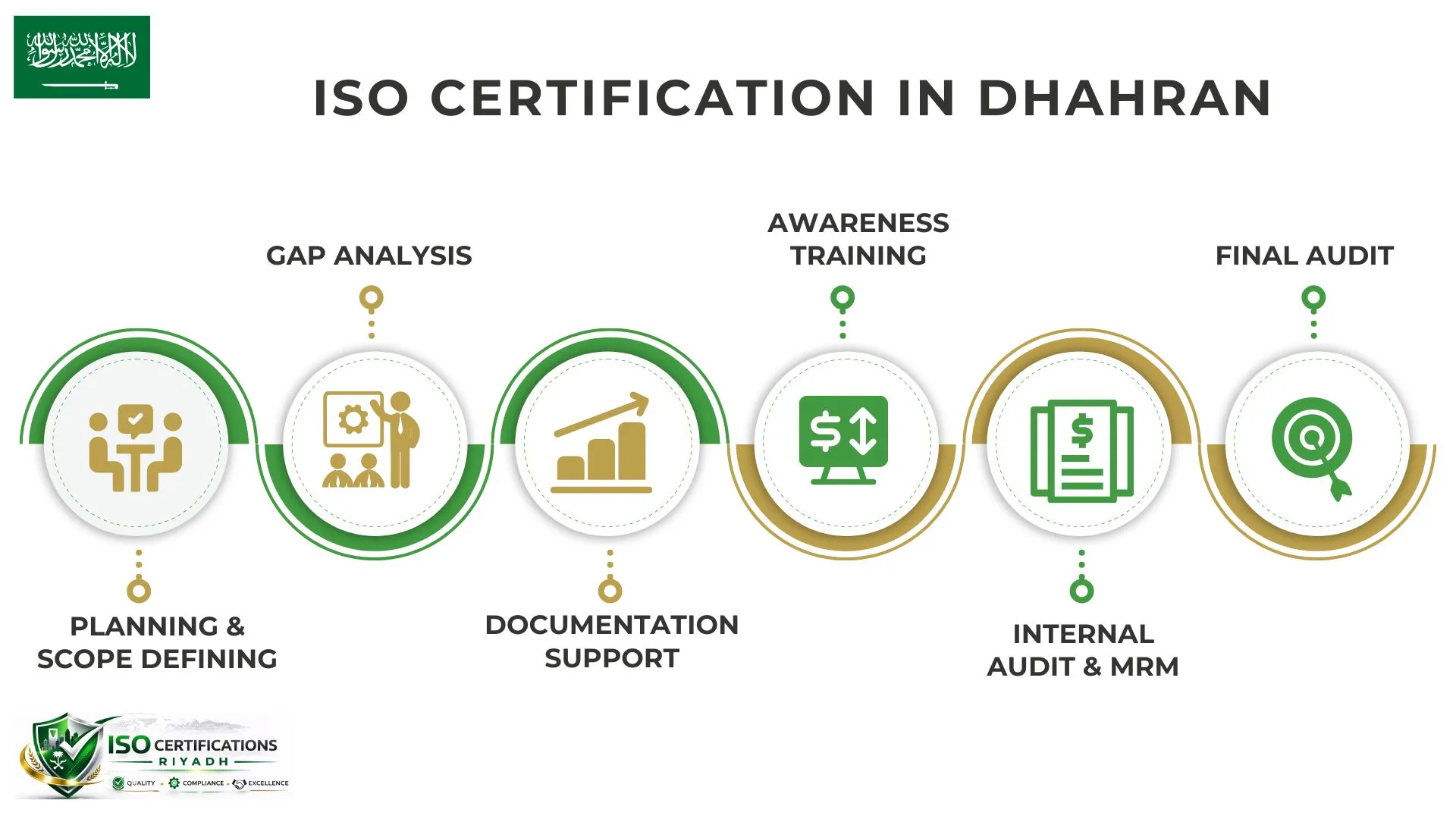
How To GetISO Certification In Dhahran- 6 Simple Steps
ISO Certification Services In Dhahran
ISO 9001 – Quality Management (QMS)
Objective: Improve quality, customer satisfaction, and operational efficiency through standardized processes.
ISO 14001 – Environmental Management (EMS)
Objective: Reduce environmental impact, control waste, and support sustainable business practices.
ISO 45001 – Occupational Health & Safety
Objective: Create a safer workplace, prevent accidents, and improve employee well-being.
ISO 27001 – Information Security Management
Objective: Protect sensitive information, reduce cyber risks, and improve data security.
ISO 22000 – Food Safety Management
Objective: Ensure food safety and hygiene throughout the food supply chain.
ISO 13485 – Medical Devices Quality Management
Objective: Ensure consistent quality and regulatory compliance for medical devices.
ISO 55001 – Asset Management
Objective: Improve asset performance, optimize maintenance, and reduce operational costs.
ISO 42001 – Artificial Intelligence Management
Objective: Establish responsible, ethical, and transparent AI governance frameworks.
ISO 50001 – Energy Management
Objective: Improve energy performance, reduce consumption, and lower operating expenses.
ISO 22301 – Business Continuity Management
Objective: Strengthen resilience and ensure business continuity during disruptions.
ISO 20000-1 – IT Service Management
Objective: Improve IT service quality, reliability, and customer satisfaction.
ISO 37001 – Anti-Bribery Management
Objective: Prevent corruption risks and demonstrate ethical business practices.
ISO 31000 – Risk Management
Objective: Identify, assess, and mitigate organizational risks effectively.
ISO 41001 – Facility Management
Objective: Enhance facility performance and improve workplace efficiency.
ISO 29001 – Oil & Gas Quality Management
Objective: Improve quality and reliability in petroleum, petrochemical, and gas industries.
ISO 28000 – Supply Chain Security Management
Objective: Enhance supply chain security and reduce logistics risks.
ISO 17025 – Testing & Calibration Laboratories
Objective: Demonstrate laboratory competence and ensure reliable testing results.
ISO 21001 – Educational Organizations Management
Objective: Improve educational services and learner satisfaction.
ISO 39001 – Road Traffic Safety Management
Objective: Reduce road traffic incidents and improve transportation safety.
CE Mark Certification
Objective: Demonstrate compliance with European regulations and access EU markets.
Halal Certification
Objective: Verify compliance with Halal requirements and expand market opportunities.
GMP Certification
Objective: Ensure products are consistently manufactured according to quality standards.
HACCP Certification
Objective: Identify food safety hazards and establish preventive control measures.
GDP Certification
Objective: Ensure proper storage, handling, and distribution of pharmaceutical products.
ISO Certification Process In Dhahran
Achieving ISO certification should not be viewed as a documentation exercise. Successful implementation requires leadership commitment, employee involvement, operational integration, performance monitoring, and continual improvement.
Our implementation methodology is designed to help organizations establish management systems that support both certification objectives and business performance.
- Business Assessment and Gap Analysis: Every project begins with understanding the organization, its business objectives, operational environment, customer expectations, regulatory obligations, and existing management practices. A detailed gap analysis is conducted against the selected ISO standard to identify areas of compliance, improvement opportunities, implementation requirements, and potential risks. This stage provides a clear implementation roadmap that aligns certification objectives with organizational priorities.
- Management System Planning and Risk Evaluation: Following the assessment, the organization's context, interested parties, risks, opportunities, objectives, and implementation priorities are evaluated. This stage helps establish the foundation of the management system by ensuring that business objectives, operational realities, stakeholder expectations, and certification requirements remain aligned.
- Documentation and Management System Development: Based on identified requirements, management system documentation, policies, procedures, operational controls, performance indicators, and supporting records are developed. Documentation is tailored to the organization's activities, operational structure, and business objectives rather than relying on generic templates.
- Implementation, Training and Organizational Integration: Management systems deliver value only when integrated into daily operations. During this stage, processes are implemented, responsibilities are assigned, employees are trained, awareness activities are conducted, and operational controls are integrated into business functions.Employees, managers, and process owners gain a clear understanding of their roles and responsibilities within the management system.
- Internal Audit and Management Review: Internal audits are conducted to evaluate implementation effectiveness, verify compliance, identify improvement opportunities, and assess overall system performance. Management reviews provide leadership with visibility into performance indicators, risks, objectives, audit results, customer feedback, resource requirements, and strategic priorities.
- Certification Audit and Continual Improvement: Once implementation activities are complete, certification audits are conducted by an accredited certification body. Following successful certification, organizations continue monitoring performance, addressing improvement opportunities, managing risks, and strengthening operational effectiveness. Continual improvement remains one of the most important principles across all ISO standards and contributes significantly to long-term business success.
Benefits of ISO Certification for Organizations In Dhahran
Organizations implementing ISO standards often achieve benefits that extend beyond certification itself.
- Improved Business Governance: ISO standards help organizations establish clearer responsibilities, stronger decision-making processes, better monitoring mechanisms, and more effective management oversight.
- Enhanced Customer Confidence: Customers increasingly prefer working with organizations that demonstrate structured management practices and a commitment to continual improvement.
- Better Risk Management: ISO standards encourage organizations to identify, evaluate, and manage risks systematically. This supports operational stability and informed decision-making.
- Stronger Operational Performance: Well-designed management systems help improve consistency, accountability, efficiency, and organizational effectiveness.
- Improved Compliance Readiness: Organizations implementing ISO standards often strengthen their ability to identify and manage legal, regulatory, contractual, and customer requirements.
- Support for Sustainable Growth: ISO certification helps organizations establish scalable systems capable of supporting expansion while maintaining control and performance.
Industries We Support In Dhahran
Energy & Oil & Gas
Engineering Services
EPC Contractors
Professional Services
Technology Companies
Research & Innovation
Manufacturing
Infrastructure Development
Cost Of ISO Certification In Dhahran
The answer depends on multiple factors because every organization has different operational requirements, certification scopes, business complexities, and implementation needs.
Key factors influencing certification costs include:
- Type of ISO standard
- Number of employees
- Number of business locations
- Industry sector
- Existing management system maturity
- Scope of certification
- Operational complexity
- Regulatory requirements
- Training requirements
- Certification body audit fees
For example:
- A technology company implementing ISO 27001 may have different requirements than a manufacturing organization implementing ISO 9001.
- An engineering consultancy may require a different implementation approach than an energy-sector supplier pursuing ISO 29001.
- Organizations implementing multiple standards through an Integrated Management System may have different cost structures than businesses pursuing a single certification.
The most effective approach is to conduct an initial assessment and determine the scope before estimating implementation and certification costs.
Why Businesses Choose ISO Certifications Riyadh.com?
Businesses across Saudi Arabia choose ISO Certifications Riyadh for professional certification consulting, practical implementation support, and reliable guidance throughout the certification process. We help organizations improve compliance, operational efficiency, customer confidence, and business performance through internationally recognized standards.
- Experienced Consultants: Skilled professionals with expertise across multiple industries and ISO standards.
- End-to-End Support: Assistance from gap analysis and documentation to audits and certification.
- Customized Solutions: Tailored approaches designed to meet specific business and industry requirements.
- Efficient Certification Process: Streamlined implementation that minimizes disruption and saves time.
- Commitment to Excellence: Focus on quality, compliance, continual improvement, and long-term business growth.
Start Your ISO Certification in Riyadh Today
Get expert guidance, fast approval, and internationally recognized ISO certification for your business in Saudi Arabia.
FAQs
What is ISO certification?
ISO certification is an independent verification that an organization’s management system conforms to the requirements of a specific international standard.
Certification demonstrates commitment to quality, sustainability, safety, information security, energy performance, business continuity, or other management objectives depending on the selected standard.
Which ISO certification is best for my organization?
The most appropriate standard depends on the organization’s activities, industry sector, customer expectations, operational risks, and business objectives.
For example:
- ISO 9001 focuses on quality management.
- ISO 14001 focuses on environmental management.
- ISO 45001 focuses on occupational health and safety.
- ISO 27001 focuses on information security.
- ISO 42001 focuses on AI governance.
- ISO 50001 focuses on energy management.
- ISO 29001 focuses on oil and gas quality management.
- ISO 22301 focuses on business continuity.
How long does ISO certification take?
Implementation timelines vary depending on organizational size, operational complexity, employee involvement, management commitment, and certification scope.
Organizations with existing management practices may complete implementation more quickly than organizations developing systems for the first time.
Is ISO certification mandatory in Saudi Arabia?
Most ISO standards are voluntary.
However, customers, government entities, multinational corporations, tenders, procurement programs, and contractual requirements may require or strongly prefer certified suppliers and service providers.
Can multiple ISO standards be implemented together?
Yes.
Many organizations implement Integrated Management Systems combining standards such as:
- ISO 9001
- ISO 14001
- ISO 45001
- ISO 27001
- ISO 50001
- ISO 22301
Integration often improves efficiency while reducing duplication of effort.
Why do organizations in Dhahran pursue ISO certification?
Organizations pursue ISO certification to improve performance, strengthen governance, manage risks, increase customer confidence, support growth, improve operational consistency, and meet stakeholder expectations.
For businesses operating within Dhahran’s highly competitive environment, certification often contributes to stronger credibility and business opportunities.