
ISO 9001:2026 Certification In Dammam, Saudi Arabia
ISO 9001:2026 Certification in Dammam, Saudi Arabia helps organizations improve quality, enhance customer satisfaction, and achieve continual business improvement through an internationally recognized Quality Management System.
ISO 9001:2026 Certification in Dammam helps organizations establish a robust Quality Management System (QMS) that improves operational efficiency, customer satisfaction, and business performance. As the world’s most recognized quality management standard, ISO 9001 provides a structured framework for managing processes, reducing errors, controlling risks, and driving continual improvement. Businesses in Dammam across industries such as manufacturing, oil and gas, construction, logistics, healthcare, and information technology implement ISO 9001 to enhance service quality and demonstrate their commitment to excellence. The certification process includes gap analysis, system development, documentation, employee training, internal audits, and an independent certification audit. Achieving ISO 9001 certification helps organizations strengthen customer confidence, improve regulatory compliance, increase operational consistency, and gain a competitive advantage in local and international markets. For businesses operating in Dammam’s growing industrial and commercial sector, ISO 9001:2026 Certification serves as a valuable tool for sustainable growth, improved performance, and long-term business success.
What is ISO 9001:2026 Certification?
ISO 9001:2026 is an internationally recognized Quality Management System standard designed to help organizations establish structured operational controls, improve process consistency, strengthen customer satisfaction practices, and support continual operational improvement.
In industrial environments, ISO 9001 helps organizations move away from reactive operational management toward a more structured and process-driven operational framework.
Many industrial companies in Dammam begin implementing ISO 9001 after facing recurring operational challenges such as:
- inconsistent production quality
- weak supplier monitoring
- recurring customer complaints
- operational inefficiencies
- project execution delays
- poor reporting visibility
- inconsistent operational workflows
- recurring corrective action failures
As industrial operations grow, maintaining process consistency across departments, suppliers, operational teams, subcontractors, warehouses, production activities, and project locations often becomes increasingly difficult.
Without structured quality controls, organizations frequently struggle with:
- recurring process failures
- production inconsistencies
- operational confusion
- supplier-related issues
- customer dissatisfaction
- rework costs
- missed project timelines
- audit preparedness gaps
A properly implemented ISO 9001 system helps industrial businesses establish stronger operational discipline, improve monitoring visibility, strengthen accountability, and reduce recurring operational inefficiencies across industrial environments.
How To Get ISO 9001 Certification In Dammam- 6 Simple Steps
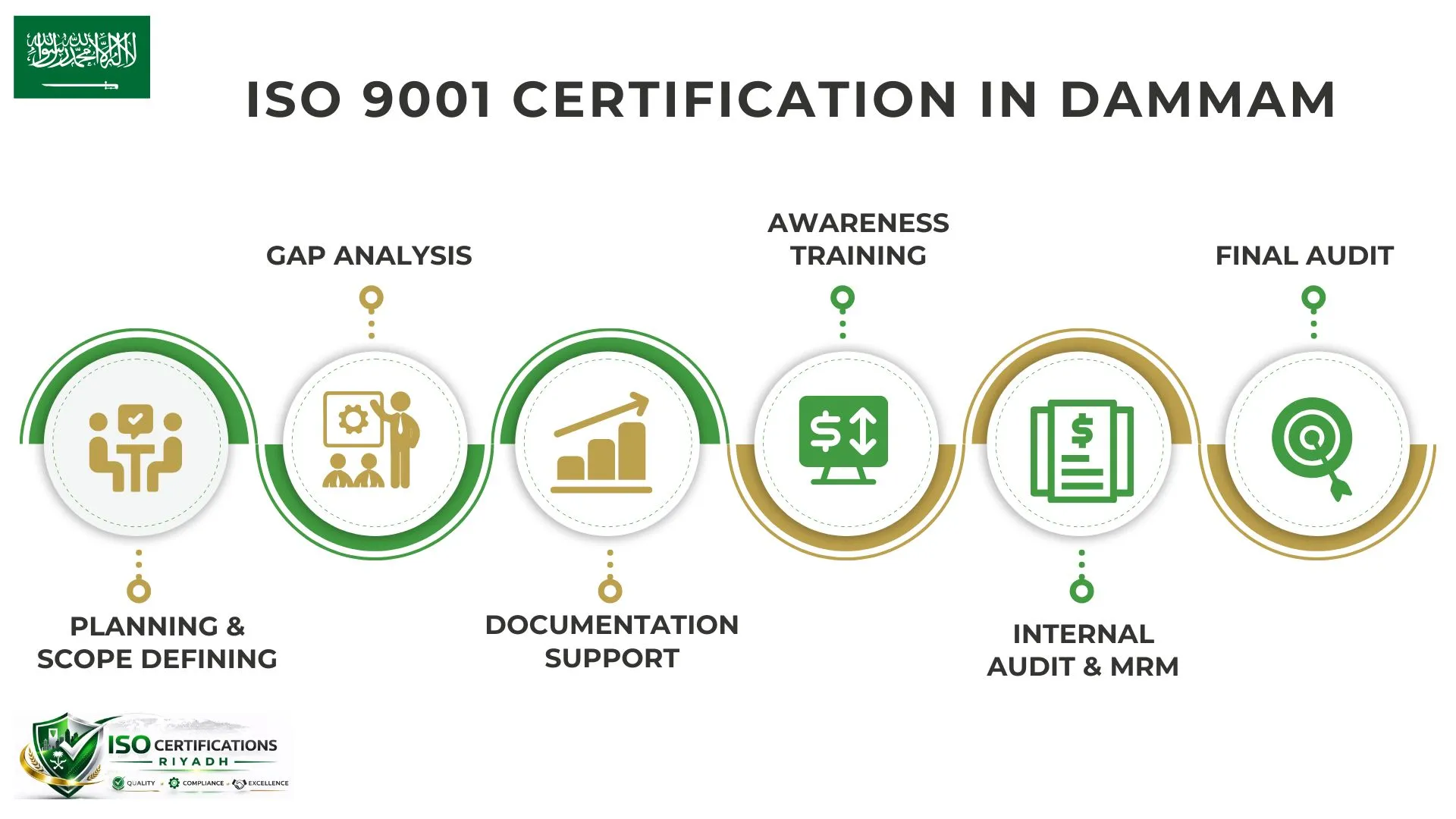
Why Industrial Businesses in Dammam are Implementing ISO 9001
Dammam’s industrial economy is heavily dependent on operational reliability, industrial process consistency, supplier accountability, contractor qualification readiness, and customer audit preparedness.
Oil & gas operators, engineering companies, EPC contractors, industrial manufacturers, and petrochemical businesses increasingly expect suppliers and contractors to demonstrate structured Quality Management Systems capable of supporting operational consistency across industrial activities.
Many businesses initially pursue ISO 9001 certification in Dammam because:
- industrial customers require certified suppliers
- contractor qualification requirements are increasing
- operational inefficiencies affect project execution
- supplier quality visibility is weak
- industrial audits are becoming stricter
- project documentation practices are inconsistent
- customer expectations are increasing
- multinational partnerships require internationally recognized standards
However, organizations that gain the most operational value from ISO 9001 are usually those that integrate quality management practices into actual industrial workflows rather than treating certification only as a documentation requirement.
A properly implemented Quality Management System helps industrial businesses improve:
- operational traceability
- industrial process monitoring
- supplier accountability
- reporting consistency
- customer confidence
- operational discipline
- corrective action visibility
- continual improvement practices
For many industrial organizations in Saudi Arabia, ISO 9001 certification also strengthens credibility during:
- refinery contractor qualification
- oil & gas supplier onboarding
- industrial customer evaluations
- EPC project participation
- multinational compliance reviews
- industrial tender approvals
Industries We Support for ISO 9001 Certification in Dammam
Different industrial sectors face different operational risks, quality challenges, and customer expectations. Because of this, ISO 9001 implementation should always align with the organization’s operational environment and industrial exposure.
- Oil & Gas Support Companies: Oil & gas support businesses often implement ISO 9001 certification to improve operational consistency, strengthen contractor qualification readiness, improve supplier monitoring visibility, and reduce recurring operational inefficiencies across project environments.
- Industrial Manufacturing Companies: Industrial manufacturers implement ISO 9001 to improve production consistency, operational monitoring visibility, supplier quality controls, corrective action management, and process traceability across manufacturing activities.
- EPC Contractors & Engineering Companies: Engineering firms and EPC contractors increasingly pursue ISO 9001 certification to strengthen project credibility, improve operational process control, improve documentation consistency, and support industrial tender qualification requirements.
- Industrial Logistics & Warehousing Operations: Industrial logistics providers and warehousing operations implement ISO 9001 to improve operational traceability, supply chain visibility, customer confidence, and process accountability across industrial logistics activities.
- Technical & Industrial Service Providers: Industrial service providers implement ISO 9001 certification to strengthen operational consistency, improve service delivery visibility, improve customer satisfaction monitoring, and support long-term operational reliability.
Our Practical ISO 9001 Implementation Approach
At ISO Certifications Riyadh, our implementation approach focuses on building practical Quality Management Systems aligned with real industrial activities rather than creating excessive documentation that operational teams rarely use.
We help organizations establish systems that improve industrial process consistency, strengthen operational accountability, improve customer confidence, and support long-term industrial scalability.
- Gap Analysis & Industrial Process Assessment
Every ISO 9001 implementation begins with understanding how the organization currently manages operational processes, industrial workflows, supplier controls, quality monitoring activities, and customer requirements.
During this stage, we evaluate:
- operational workflows
- industrial process consistency
- supplier quality controls
- customer expectations
- operational risks
- process monitoring mechanisms
- reporting visibility
- compliance practices
The objective is to identify operational gaps and establish a realistic implementation roadmap aligned with the organization’s industrial environment and operational priorities.
This stage helps businesses improve visibility into operational inefficiencies before implementation activities begin.
- Quality Documentation & Operational Control Development
Once implementation gaps are identified, we help organizations establish practical Quality Management System documentation and operational controls aligned with actual industrial activities.
This typically includes:
- quality policies
- SOPs
- industrial process controls
- operational monitoring mechanisms
- quality objectives
- reporting structures
- corrective action procedures
- compliance records
Our focus is not creating unnecessary paperwork. Instead, we establish systems that industrial teams can realistically follow and management can effectively monitor across day-to-day operations.
- System Implementation & Employee Awareness
Documentation alone does not improve operational quality unless the system becomes integrated into actual industrial workflows.
During implementation, we work closely with departments to integrate quality controls, operational monitoring activities, reporting structures, and accountability mechanisms into operational environments.
Awareness sessions help employees understand:
- operational responsibilities
- process controls
- quality objectives
- reporting expectations
- corrective action practices
- customer-focused operational requirements
This stage is critical because many operational failures occur due to inconsistent execution rather than lack of documentation alone.
A successful ISO 9001 implementation ensures quality management becomes part of operational culture rather than an isolated compliance activity.
- Internal Audit & Management Review
Internal audits are conducted to evaluate implementation effectiveness, identify operational gaps, assess industrial process controls, and review whether quality practices are functioning effectively across operational activities.
Management review activities help leadership evaluate:
- operational performance
- customer feedback
- process effectiveness
- industrial risks
- corrective actions
- improvement opportunities
This stage improves operational visibility while strengthening accountability and industrial audit preparedness across the organization.
Rather than treating internal audits as a checklist exercise, we focus on helping businesses use audits as operational improvement tools.
- Certification Audit & Continual Improvement Support
Once the organization is operationally prepared, the ISO 9001 certification audit process is coordinated with the certification body.
During this stage, we support organizations with:
- certification audit preparation
- audit coordination
- corrective action guidance
- nonconformity closure support
- continual improvement planning
However, certification should never be viewed as the final objective.
Organizations that gain the most value from ISO 9001 are usually those that continue improving operational controls, industrial process consistency, supplier quality visibility, and monitoring activities after certification is completed.
Benefits of ISO 9001 Certification for Industrial Businesses in Dammam
A properly implemented ISO 9001 Quality Management System provides operational and commercial value beyond certification itself.
- Improved Industrial Process Consistency: ISO 9001 helps organizations standardize operational workflows, strengthen industrial process controls, improve monitoring visibility, and reduce recurring operational inconsistencies across industrial activities.
- Better Contractor & Customer Confidence: Oil & gas operators, EPC contractors, industrial customers, and multinational organizations increasingly prefer working with businesses that demonstrate structured quality management systems and operational accountability.
- Stronger Supplier Quality Visibility: Organizations implementing ISO 9001 often improve supplier monitoring practices, strengthen procurement visibility, improve operational traceability, and reduce recurring supplier-related operational failures.
- Reduced Operational Inefficiencies & Rework: In industrial environments, recurring operational inefficiencies often lead to production delays, project disruptions, material wastage, rework costs, and customer dissatisfaction. A properly implemented Quality Management System helps organizations identify process gaps earlier and establish stronger corrective action controls capable of reducing recurring operational failures.
- Improved Audit & Contractor Qualification Readiness: ISO 9001 helps industrial businesses maintain structured documentation, operational evidence, process visibility, and corrective action controls that improve audit preparedness and contractor qualification readiness.
- Better Long-Term Industrial Scalability: As industrial operations expand, ISO 9001 helps organizations establish structured operational frameworks capable of supporting sustainable growth and long-term operational reliability.
ISO 9001 Certification Cost in Dammam, Saudi Arabia
The cost of ISO 9001:2026 certification in Dammam depends on several industrial and operational factors rather than a fixed standard price.
Many businesses searching for:
- ISO 9001 certification cost in Dammam
- ISO consultants for industrial companies
- ISO certification for oil & gas contractors
- ISO 9001 consultants for manufacturing companies
- ISO certification for EPC contractors in Saudi Arabia
often assume certification pricing depends only on the certificate itself.
In reality, implementation and certification costs are usually influenced by:
- organization size
- industrial complexity
- operational risks
- number of employees
- operational locations
- industrial process scope
- supplier dependencies
- documentation maturity
- operational monitoring requirements
Industrial businesses operating across refinery projects, manufacturing plants, EPC environments, or oil & gas support operations generally require broader implementation coverage compared to smaller office-based environments.
Why Businesses Choose ISO Certifications Riyadh.com for ISO 9001 Certification in Dammam?
Organizations across Saudi Arabia choose ISO Certifications Riyadh because our consulting approach focuses on practical industrial implementation rather than generic compliance documentation.
We understand that operational challenges vary significantly between oil & gas contractors, industrial manufacturers, engineering companies, refinery support businesses, logistics providers, and industrial service organizations.
Because of this, our ISO 9001 consulting approach focuses on:
- practical industrial controls
- operational integration
- supplier quality visibility
- industrial process monitoring
- contractor qualification readiness
- audit preparedness
- employee awareness
- continual improvement
Rather than creating systems that exist only for certification audits, we help organizations establish Quality Management Systems that support real industrial reliability and long-term operational growth.
Start Your ISO Certification in Riyadh Today
Get expert guidance, fast approval, and internationally recognized ISO certification for your business in Saudi Arabia.
FAQs
Why do industrial companies in Dammam require ISO 9001 certification?
Industrial businesses often require ISO 9001 certification to improve operational consistency, strengthen supplier quality visibility, improve contractor qualification readiness, reduce recurring operational inefficiencies, and support customer audit expectations.
Which industries commonly implement ISO 9001 in Dammam?
ISO 9001 is widely implemented across oil & gas support operations, industrial manufacturing companies, EPC contractors, engineering firms, industrial logistics providers, refinery support businesses, and industrial service organizations.
How long does the ISO 9001 certification process take?
Implementation timelines depend on organization size, industrial complexity, operational risks, number of departments, operational locations, and existing management system maturity.
How much does ISO 9001 certification cost in Dammam?
ISO 9001 certification cost depends on factors such as organization size, industrial activities, operational complexity, number of locations, certification scope, and implementation requirements.
Do you provide ISO 9001 consulting services across Saudi Arabia?
Yes. We provide ISO 9001 consulting, implementation support, internal audits, awareness training, documentation development, and certification preparation services across Dammam and throughout Saudi Arabia.