
Halal Certification in Dammam, Saudi Arabia
ISO 45001:2018 Certification in Dammam, Saudi Arabia helps organizations create a safer workplace, reduce occupational risks, and improve employee health and safety through an effective Occupational Health and Safety Management System.
Halal Certification in Dammam helps businesses demonstrate that their products, ingredients, production processes, and handling practices comply with recognized Halal requirements. It is an important certification for organizations operating in the food, beverage, cosmetics, pharmaceutical, logistics, and hospitality sectors that serve Muslim consumers and international Halal markets. Halal certification verifies that products are manufactured, processed, stored, and distributed according to approved Halal guidelines while maintaining product integrity throughout the supply chain. The certification process typically includes a review of ingredients, supplier verification, production controls, hygiene practices, documentation assessment, and an independent audit. Achieving Halal certification enhances consumer confidence, supports regulatory and market requirements, and strengthens brand credibility in local and global markets. For businesses in Dammam seeking to expand their market reach and meet customer expectations, Halal Certification provides a structured framework for demonstrating compliance, improving operational transparency, and building trust among consumers, business partners, and regulatory authorities.
What is Halal Certification?
Halal Certification is a formal certification process that confirms products, ingredients, manufacturing operations, storage practices, and distribution activities comply with recognized Halal requirements. It is commonly applied in industries such as food and beverages, cosmetics, pharmaceuticals, personal care products, and logistics. The certification ensures that products are sourced, produced, handled, and stored according to approved Halal guidelines while maintaining integrity throughout the supply chain. Obtaining Halal Certification helps businesses build customer confidence, improve brand reputation, meet market and regulatory requirements, and access growing Halal markets locally and internationally. It also demonstrates a commitment to quality, transparency, and compliance.
Many businesses in Dammam begin pursuing Halal certification after facing operational challenges such as:
- weak ingredient traceability
- supplier compliance concerns
- export customer requirements
- inconsistent operational controls
- hygiene monitoring gaps
- customer trust issues
- operational documentation weaknesses
- product qualification requirements
As food and manufacturing operations expand, maintaining consistent Halal compliance visibility across suppliers, warehouses, kitchens, production activities, transportation environments, and operational teams often becomes increasingly difficult.
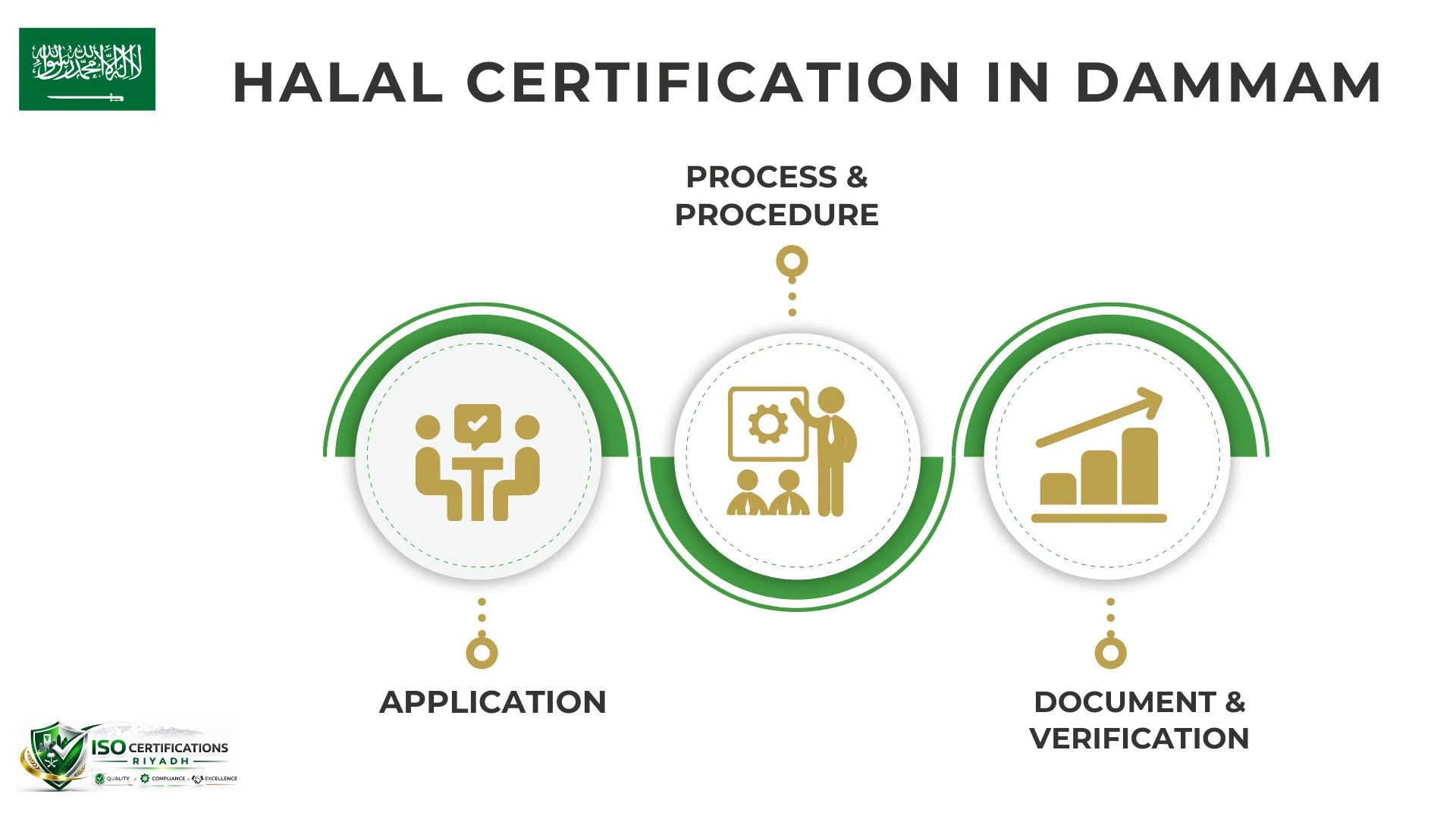
How To Get Halal Certification In Dammam- 6 Simple Steps
Industries We Support for Halal Certification in Dammam
Different industries face different ingredient risks, operational challenges, and compliance obligations. Because of this, Halal implementation should always align with the organization’s operational environment and product exposure.
- Oil & Gas Support Companies: Oil & gas support businesses often implement ISO 45001 certification to improve workplace safety visibility, strengthen contractor safety accountability, improve operational hazard monitoring, and support refinery qualification requirements across project environments.
- EPC Contractors & Engineering Companies: Engineering firms and EPC contractors increasingly pursue ISO 45001 certification to strengthen operational safety discipline, improve project risk visibility, support industrial tender qualification, and improve contractor safety accountability across project activities.
- Industrial Manufacturing Companies: Industrial manufacturers implement ISO 45001 to improve workplace safety controls, strengthen hazard monitoring practices, improve workforce awareness visibility, and reduce recurring workplace incidents across manufacturing environments.
- Construction & Infrastructure Companies: Construction companies implement ISO 45001 certification to improve operational safety monitoring, strengthen contractor coordination, improve hazard control visibility, and support long-term project safety management.
- Industrial Logistics & Warehousing Operations: Industrial logistics providers and warehousing operations implement ISO 45001 to improve material handling safety, strengthen operational hazard monitoring, improve workforce safety awareness, and reduce operational incident exposure across logistics environments.
Our Practical Halal Certification Approach
At ISO Certifications Riyadh, our implementation approach focuses on helping organizations establish practical Halal compliance systems aligned with real operational activities rather than creating excessive documentation that operational teams rarely use.
We help organizations improve traceability visibility, strengthen operational discipline, improve compliance accountability, and support long-term customer confidence.
- Halal Compliance Assessment & Operational Gap Analysis
Every Halal certification project begins with understanding the organization’s products, ingredients, suppliers, operational activities, hygiene controls, and traceability practices.
During this stage, we evaluate:
- ingredient sourcing
- supplier visibility
- operational hygiene practices
- storage controls
- contamination risks
- product handling activities
- operational traceability
- compliance documentation visibility
The objective is to identify operational compliance gaps and establish a realistic implementation roadmap aligned with the organization’s operational environment and business objectives.
This stage helps businesses improve visibility into compliance weaknesses before certification activities begin.
- Operational Control Implementation & Documentation Support
Once compliance gaps are identified, we help organizations establish practical operational controls and documentation aligned with actual production and operational activities.
This typically includes:
- ingredient traceability controls
- supplier monitoring practices
- operational hygiene procedures
- storage monitoring controls
- contamination prevention mechanisms
- operational compliance records
- product handling procedures
- internal monitoring visibility
Our focus is not creating unnecessary paperwork. Instead, we establish systems that operational teams can realistically maintain and management can effectively monitor across day-to-day environments.
- Audit Preparation & Halal Certification Support
Once operational controls and documentation are prepared, final audit preparation and certification support activities are coordinated.
During this stage, we support organizations with:
- certification audit preparation
- operational compliance reviews
- corrective action guidance
- nonconformity closure support
- audit coordination
- certification readiness activities
A properly managed Halal certification process helps businesses strengthen customer confidence, improve export readiness, reduce operational compliance risks, and support long-term commercial growth.
Benefits of Halal Certification for Businesses in Dammam
A properly managed Halal certification process provides operational and commercial value beyond certification itself.
- Improved Customer & Market Confidence: Customers, distributors, retailers, hospitality businesses, and export buyers increasingly prefer working with organizations that demonstrate structured Halal compliance visibility and operational accountability.
- Better Ingredient Traceability & Supplier Visibility: Halal certification helps organizations improve ingredient monitoring visibility, strengthen supplier accountability, improve operational traceability, and support long-term product reliability.
- Reduced Operational Compliance Risks: Food and manufacturing operations often face recurring risks related to supplier inconsistencies, ingredient visibility gaps, contamination exposure, operational hygiene weaknesses, and customer approval concerns.
- Improved Export & Supplier Qualification Readiness: Halal certification often strengthens credibility during export qualification reviews, supplier onboarding evaluations, hospitality vendor approvals, and international customer assessments.
- Stronger Operational Hygiene & Product Handling Controls: Organizations implementing Halal compliance systems often improve operational discipline, hygiene monitoring consistency, storage visibility, and contamination prevention accountability across operational environments.
- Better Long-Term Commercial Scalability: As businesses expand into regional and international markets, Halal compliance systems help organizations establish structured operational frameworks capable of supporting sustainable commercial growth and long-term market reliability.
Halal Certification Cost in Dammam, Saudi Arabia
The cost of Halal Certification in Dammam depends on several operational and product-related factors rather than a fixed standard price.
Many businesses searching for:
- Halal certification cost in Dammam
- Halal consultants for food manufacturers
- Halal certification for restaurants
- Halal certification for export companies
- Halal compliance services in Saudi Arabia
often assume pricing depends only on the final certificate itself.
In reality, implementation and certification costs are usually influenced by:
- product categories
- ingredient complexity
- supplier dependencies
- operational hygiene exposure
- manufacturing activities
- operational locations
- traceability requirements
- export requirements
- operational monitoring scope
Organizations operating across food manufacturing plants, restaurants, meat processing operations, export-oriented businesses, or cosmetics production environments generally require broader operational compliance implementation coverage compared to smaller standalone operations.
Why Businesses Choose ISO Certifications Riyadh.com for Halal Certification in Dammam?
Organizations across Saudi Arabia choose ISO Certifications Riyadh because our consulting approach focuses on practical operational compliance implementation rather than generic certification documentation.
We understand that operational compliance challenges vary significantly between food manufacturers, restaurants, catering businesses, export companies, cosmetics manufacturers, packaging businesses, and consumer product operations.
Because of this, our Halal consulting approach focuses on:
- practical operational controls
- ingredient traceability visibility
- supplier accountability
- hygiene monitoring consistency
- operational integration
- audit preparedness
- workforce awareness
- long-term compliance reliability
Rather than creating documentation that exists only for certification activities, we help organizations establish practical Halal compliance systems that support real operational accountability and long-term customer trust.
Start Your ISO Certification in Riyadh Today
Get expert guidance, fast approval, and internationally recognized ISO certification for your business in Saudi Arabia.
FAQs
Why do industrial companies in Dammam require ISO 45001 certification?
Industrial businesses often require ISO 45001 certification to improve workplace safety visibility, strengthen contractor safety accountability, reduce operational hazard exposure, improve workforce awareness, and support customer compliance expectations.
Which industries commonly implement ISO 45001 in Dammam?
ISO 45001 is widely implemented across oil & gas support operations, EPC contractors, industrial manufacturing companies, refinery support services, engineering firms, construction businesses, and industrial logistics operations.
How long does the ISO 45001 certification process take?
Implementation timelines depend on organization size, operational hazard exposure, industrial complexity, workforce activities, operational locations, and existing workplace safety management maturity.
How much does ISO 45001 certification cost in Dammam?
ISO 45001 certification cost depends on factors such as organization size, operational risks, industrial activities, workforce exposure, number of locations, certification scope, and implementation requirements.