
ISO/IEC 27001:2022 Certification in Jubail, Saudi Arabia
Information Security Management System Consulting Services for Manufacturing, Petrochemical, Engineering and Industrial Organizations
ISO/IEC 27001:2022 Certification in Jubail helps organizations establish a robust Information Security Management System (ISMS) to protect sensitive information, business data, intellectual property, and critical digital assets. As one of Saudi Arabia’s leading industrial and commercial hubs, Jubail is home to organizations that rely heavily on secure information systems and data-driven operations. ISO/IEC 27001 provides a risk-based framework for identifying information security threats, managing vulnerabilities, implementing security controls, and ensuring the confidentiality, integrity, and availability of information. Businesses in Jubail across sectors such as petrochemicals, oil and gas, manufacturing, logistics, engineering, healthcare, finance, and technology implement ISO 27001 to strengthen cybersecurity and meet regulatory, contractual, and customer requirements. The certification process includes risk assessments, security policy development, control implementation, employee awareness training, internal audits, and certification audits. Achieving ISO/IEC 27001 certification enhances customer trust, improves business resilience, reduces cybersecurity risks, and demonstrates a strong commitment to information security, compliance, and operational excellence.
What is ISO/IEC 27001:2022 Certification?
ISO/IEC 27001:2022 is the internationally recognized standard for Information Security Management Systems (ISMS).
The standard provides organizations with a systematic approach to identifying, assessing, treating, monitoring, and improving information security risks.
Rather than focusing solely on technology, ISO 27001 addresses information security from a business perspective by considering:
- People
- Processes
- Technology
- Governance
- Risk management
- Continual improvement
The standard helps organizations protect information from threats such as:
- Cyberattacks
- Unauthorized access
- Data leakage
- Insider threats
- Malware
- Ransomware
- Human error
- Third-party risks
A properly implemented Information Security Management System improves organizational resilience while supporting customer confidence and regulatory compliance.
Why Businesses in Jubail Pursue ISO 27001 Certification
- Protecting Critical Business Information: Organizations rely on information assets to support decision-making, operations, customer relationships, and business growth. ISO 27001 helps establish controls that protect information from loss, alteration, unauthorized disclosure, and misuse.
- Managing Cybersecurity Risks: Cybersecurity threats continue to evolve in sophistication and frequency. Organizations implementing ISO 27001 establish structured processes for identifying cybersecurity risks, implementing controls, monitoring effectiveness, and continually improving security practices.
- Supporting Customer and Contractual Requirements: Many customers increasingly require suppliers and service providers to demonstrate information security maturity. ISO 27001 certification helps strengthen trust during supplier assessments, customer audits, and contract negotiations.
- Improving Vendor and Third-Party Security Oversight: Organizations frequently share information with suppliers, contractors, consultants, and service providers. ISO 27001 helps establish processes for evaluating third-party security risks and protecting information throughout the supply chain.
- Supporting Digital Transformation Initiatives: As organizations adopt cloud platforms, automation technologies, AI solutions, and digital workflows, information security becomes increasingly important. ISO 27001 helps ensure that digital transformation activities are supported by effective governance and risk management practices.
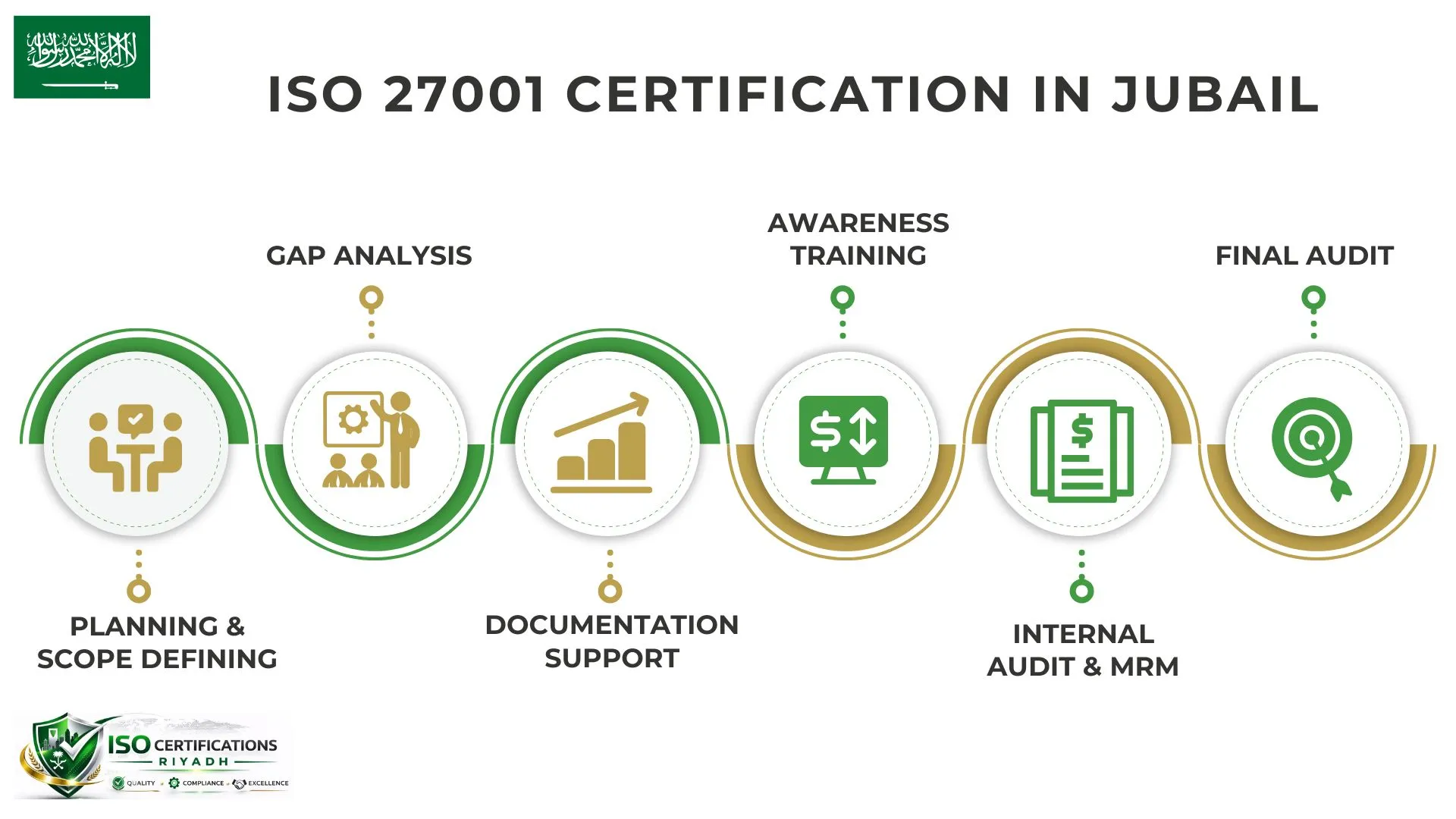
How To Get, ISO 27001 Certification In Jubail- 6 Simple Steps
Common Information Security Challenges Faced by Businesses in Jubail
Many organizations face recurring information security challenges including:
- Phishing and Social Engineering Attacks: Employees continue to be targeted through increasingly sophisticated phishing attempts.
- Unauthorized Access:Weak access management practices can expose sensitive information to unnecessary risks.
- Third-Party Security Risks: Suppliers and service providers may introduce information security vulnerabilities.
- Data Leakage: Improper information handling practices can result in accidental or intentional data disclosure.
- Ransomware Threats:Ransomware attacks continue to impact organizations across industries.
- Lack of Security Awareness:Employees often remain one of the most significant information security risk factors.
Industries We Support for ISO 27001 Certification in Jubail
- Information Technology Companies: Protect sensitive data, strengthen cybersecurity, and improve information security management.
- Healthcare Organizations: Secure patient records, medical information, and confidential healthcare data.
- Financial Services and Banking Institutions: Manage information security risks and protect financial and customer information.
- Oil and Gas Companies: Safeguard operational data, critical infrastructure information, and business-critical systems.
- Engineering and Consulting Firms: Protect intellectual property, project data, and confidential client information.
- Logistics and Supply Chain Organizations: Secure digital systems, operational data, and information shared across the supply chain.
Our ISO/IEC 27001:2022 Implementation Methodology
- Information Security Assessment, Gap Analysis and Business Understanding: Every ISO 27001 implementation project begins with understanding how information flows throughout the organization. This includes evaluating business processes, information assets, customer requirements, contractual obligations, technology infrastructure, operational dependencies, and existing security controls. A detailed gap assessment is conducted against ISO/IEC 27001:2022 requirements to identify strengths, weaknesses, vulnerabilities, compliance gaps, and improvement opportunities. This provides a clear understanding of the organization's current information security maturity.
- Information Asset Identification, Risk Assessment and Security Planning: Information is one of an organization's most valuable business assets. During this stage, information assets are identified, classified, and evaluated to understand their importance to business operations. Security risks associated with confidentiality, integrity, and availability are assessed. Potential threats such as cyberattacks, unauthorized access, phishing attempts, ransomware incidents, insider threats, data leakage, and third-party vulnerabilities are evaluated.
- Information Security Management System Design and Documentation Development: Once risks and requirements have been identified, the Information Security Management System is developed. This includes establishing: Information Security Policy Risk Assessment Methodology Risk Treatment Plan Asset Management Processes Access Control Procedures Incident Management Procedures Supplier Security Controls Business Continuity Interfaces Monitoring and Reporting Mechanisms Statement of Applicability (SoA) Documentation is developed around actual business activities and operational requirements rather than generic templates.
- Operational Implementation, Security Awareness and Control Deployment: Once the framework has been developed, security controls are implemented throughout the organization. Employees receive information security awareness training to help them understand cyber threats, phishing risks, password management requirements, data handling responsibilities, and incident reporting procedures. Access controls, monitoring mechanisms, asset management processes, supplier controls, backup procedures, and security governance activities are integrated into daily operations.
- Security Performance Evaluation, Internal Audit and Management Review: Organizations must regularly evaluate whether security controls remain effective and whether information security objectives are being achieved. Internal audits are conducted to verify compliance, assess control effectiveness, identify vulnerabilities, and evaluate improvement opportunities. Security incidents, audit findings, risk assessments, corrective actions, and performance indicators are reviewed. Management reviews provide leadership with visibility into information security risks, business impacts, customer expectations, resource requirements, and continual improvement opportunities.
- Certification Audit and Continual Security Improvement: Once implementation is complete, certification audits are conducted by an accredited certification body to assess conformity with ISO/IEC 27001:2022 requirements. Any identified findings are addressed through corrective actions and continual improvement activities. Certification demonstrates commitment to information security, but long-term value comes from maintaining and strengthening security practices over time.
Benefits of ISO 27001 Certification for Businesses in Jubail
- Protection of Sensitive Business Information:Organizations operating in Jubail often manage large volumes of engineering documentation, customer information, project records, supplier data, contracts, financial information, and operational records.ISO 27001 helps establish controls that protect these information assets from unauthorized access, disclosure, alteration, or loss.
- Improved Cybersecurity Risk Management:Cybersecurity threats continue to evolve rapidly across industries.ISO 27001 provides a structured approach to identifying, assessing, treating, monitoring, and reducing cybersecurity risks. Organizations gain greater visibility into vulnerabilities while improving their ability to respond to emerging threats.This proactive approach supports long-term business protection.
- Better Customer and Client Confidence: Customers increasingly expect organizations to demonstrate strong information security practices. ISO 27001 certification provides assurance that information is managed systematically and that security risks are actively monitored and controlled. This often strengthens customer relationships and supports supplier qualification activities.
- Stronger Protection of Engineering and Project Information:Engineering contractors, manufacturing companies, and industrial service providers frequently manage confidential project documentation and proprietary information.Loss or compromise of such information can create operational, financial, and reputational consequences.ISO 27001 helps establish controls that support secure information handling throughout project lifecycles.
- Improved Third-Party Security Management:Organizations frequently exchange information with suppliers, contractors, consultants, cloud service providers, and business partners. ISO 27001 helps establish structured approaches for evaluating third-party security risks and protecting information throughout the supply chain.This reduces exposure to risks introduced by external parties.
- Better Incident Management and Response: Despite preventive measures, security incidents can still occur.ISO 27001 helps organizations establish incident reporting, investigation, response, escalation, and recovery processes that improve preparedness and reduce potential impacts. Organizations become more resilient and capable of responding effectively when incidents occur.
ISO 27001 Certification Cost in Jubail, Saudi Arabia
The cost of ISO 27001 certification depends on multiple factors rather than a fixed pricing model.
Key factors include:
- Number of employees
- Scope of certification
- Number of business locations
- Complexity of operations
- Existing information security controls
- Technology infrastructure
- Regulatory requirements
- Third-party dependencies
- Risk profile
- Certification body fees
Manufacturing organizations, engineering contractors, petrochemical companies, and industrial service providers often require broader implementation activities due to operational complexity and information security requirements.
A detailed assessment is generally required before determining implementation effort and certification costs.
Why Organizations Choose ISO Certifications Riyadh for ISO 27001 Certification in Jubail?
Organizations choose ISO Certifications Riyadh because we understand both information security requirements and the operational realities of industrial businesses.
We recognize that information security challenges faced by petrochemical companies, manufacturing facilities, engineering contractors, logistics organizations, and industrial service providers differ significantly from those faced by purely technology-focused businesses.
Our consulting approach focuses on helping organizations build Information Security Management Systems that support:
- Risk reduction
- Customer confidence
- Cybersecurity governance
- Compliance readiness
- Operational resilience
- Sustainable business growth
Our services include:
- Information Security Gap Analysis
- Risk Assessments
- Documentation Development
- Security Awareness Training
- Internal Audits
- Management Review Support
- Certification Preparation
- Continual Improvement Guidance
The objective is to help organizations establish effective and sustainable information security management practices rather than pursuing certification as a standalone activity.
Start Your ISO Certification in Riyadh Today
Get expert guidance, fast approval, and internationally recognized ISO certification for your business in Saudi Arabia.
FAQs
What is ISO/IEC 27001:2022 certification?
ISO/IEC 27001:2022 is an internationally recognized Information Security Management System (ISMS) standard that helps organizations systematically identify, assess, manage, and reduce information security risks.
The standard provides a framework for protecting information assets while improving cybersecurity governance and organizational resilience.
Why is ISO 27001 important for businesses in Jubail?
Organizations operating in Jubail increasingly rely on digital systems, engineering data, project information, supplier records, customer information, and business-critical information assets.
ISO 27001 helps protect these assets from cyber threats, unauthorized access, data leakage, and other information security risks.
Which industries commonly implement ISO 27001 in Jubail?
Industries commonly implementing ISO 27001 include:
- Petrochemical companies
- Manufacturing organizations
- Engineering contractors
- EPC companies
- Industrial service providers
- Logistics companies
- Warehousing operators
- Energy-sector suppliers
- Technology service providers
- Corporate service organizations
How much does ISO 27001 certification cost in Jubail?
Costs vary depending on organizational size, certification scope, technology infrastructure, operational complexity, risk profile, number of locations, and certification body requirements.
A detailed assessment is typically required before determining implementation effort and certification costs.
How long does ISO 27001 implementation take?
Implementation timelines vary depending on organizational readiness, existing security controls, resource availability, and project scope.
Organizations with mature security practices generally progress faster than organizations implementing information security management systems for the first time.