
ISO/IEC 42001:2023 Certification in Jubail, Saudi Arabia
ISO/IEC 42001:2023 Certification in Dhahran, Saudi Arabia helps organizations establish responsible AI governance, manage AI-related risks, and ensure the ethical and effective use of artificial intelligence systems.
ISO/IEC 42001:2023 Certification in Jubail helps organizations establish a structured Artificial Intelligence Management System (AIMS) for the responsible development, deployment, and governance of AI technologies. As the world’s first international standard for AI management systems, ISO/IEC 42001 provides a framework for managing AI-related risks, ensuring transparency, promoting accountability, and supporting ethical AI practices. Organizations in Jubail across industries such as petrochemicals, manufacturing, technology, healthcare, logistics, finance, engineering, and government services implement ISO/IEC 42001 to strengthen AI governance and build stakeholder confidence. The certification process includes AI risk assessments, policy development, governance framework implementation, performance monitoring, employee awareness training, internal audits, and certification audits. Achieving ISO/IEC 42001 certification demonstrates an organization’s commitment to responsible AI usage, regulatory compliance, data protection, and continual improvement. For businesses in Jubail embracing digital transformation and artificial intelligence, ISO/IEC 42001:2023 Certification provides a trusted framework for managing AI systems effectively while supporting innovation, transparency, operational excellence, and sustainable business growth.
What is ISO/IEC 42001:2023 Certification?
ISO/IEC 42001:2023 is the international Artificial Intelligence Management System (AIMS) standard.
The standard helps organizations establish policies, governance structures, controls, and processes for the responsible management of AI systems.
ISO 42001 focuses on:
- AI governance
- AI risk management
- Accountability
- Transparency
- Human oversight
- Ethical considerations
- Data management
- Security
- Performance monitoring
- Continual improvement
Unlike technical AI standards that focus on algorithms or software development, ISO 42001 focuses on how organizations govern AI throughout its lifecycle.
The objective is to ensure AI systems remain trustworthy, responsible, effective, and aligned with organizational objectives.
Why AI Governance is Becoming Important in Jubail
The Rise of AI Across Industrial Operations
Industrial organizations throughout Jubail are increasingly adopting Artificial Intelligence technologies to improve productivity, reduce costs, optimize maintenance activities, strengthen quality control, and support operational decision-making.
Examples include:
- Predictive maintenance systems
- AI-powered quality inspection
- Production forecasting
- Intelligent process monitoring
- Industrial analytics platforms
- Supply chain optimization
- AI-driven operational reporting
- Engineering design assistance
- Workforce planning tools
- Customer service automation
As dependence on AI increases, organizations must ensure that decisions made by AI systems remain reliable, transparent, and aligned with business objectives. Without effective governance, organizations may face risks related to inaccurate outputs, poor data quality, bias, lack of accountability, cybersecurity vulnerabilities, and regulatory concerns. ISO 42001 provides a framework that helps organizations manage these risks while maximizing the value of AI investments.
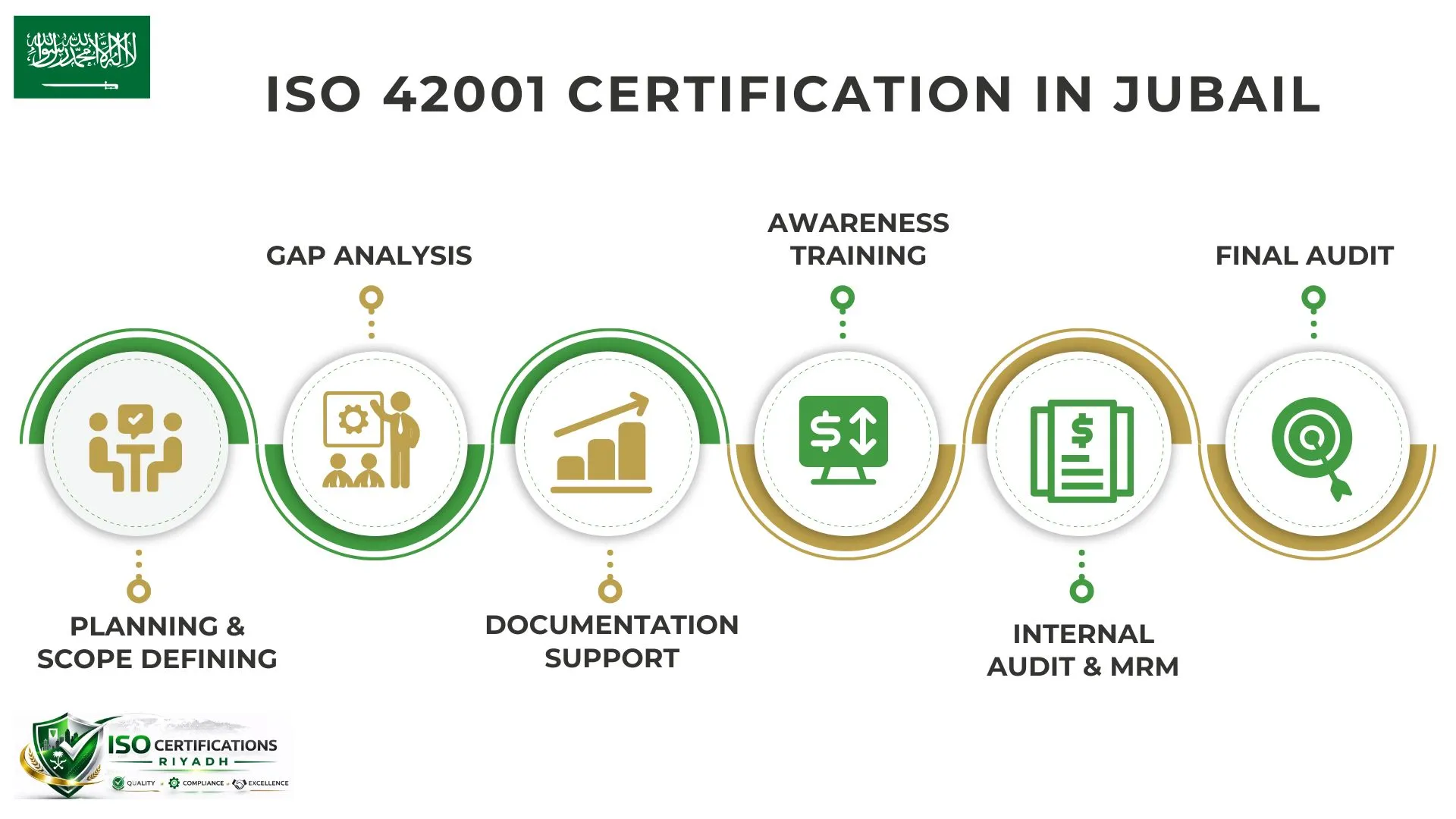
How To Get, ISO 42001 Certification In Jubail - 6 Simple Steps
Why Businesses in Jubail Pursue ISO 42001 Certification
- Establishing Responsible AI Governance: Many organizations are implementing AI technologies faster than governance frameworks. ISO 42001 helps establish structured governance mechanisms that ensure AI initiatives remain aligned with organizational objectives, stakeholder expectations, and risk management priorities. This enables organizations to scale AI adoption with greater confidence and accountability.
- Managing AI Risks Effectively
AI systems can create risks that traditional management systems may not fully address.
These risks may include:
- Incorrect outputs
- Algorithmic bias
- Lack of transparency
- Data integrity concerns
- Cybersecurity vulnerabilities
- Regulatory uncertainty
- Human oversight failures
ISO 42001 helps organizations identify, assess, treat, monitor, and continually manage AI-related risks.
- Supporting Customer and Stakeholder Confidence: Customers increasingly want assurance that AI systems are used responsibly and that decisions influenced by AI are reliable and explainable.ISO 42001 certification demonstrates commitment to responsible AI management and governance.This can strengthen trust among customers, regulators, business partners, and investors.
- Supporting Digital Transformation Strategies: Many organizations in Jubail are investing heavily in automation, analytics, Industry 4.0 initiatives, and digital transformation programs. ISO 42001 helps ensure these initiatives are supported by appropriate governance, risk management, and accountability structures. This improves sustainability and long-term effectiveness of AI programs.
- Improving AI Lifecycle Management: Organizations often focus on deploying AI systems but may not establish adequate controls for monitoring, reviewing, updating, and improving those systems. ISO 42001 encourages management throughout the entire AI lifecycle, helping organizations maintain effectiveness and reliability over time.
Industries We Support for ISO 42001 Certification in Jubail
- Technology and Software Companies: Establish responsible AI governance and manage AI-related risks across digital products and services.
- Healthcare Organizations: Ensure ethical and secure use of AI in patient care, diagnostics, and healthcare operations.
- Financial Services and Banking Institutions: Strengthen AI governance, risk management, and compliance in financial technologies and decision-making systems.
- Manufacturing and Industrial Organizations: Manage AI applications in automation, predictive maintenance, and operational optimization.
- Telecommunications Companies: Improve governance and oversight of AI-driven networks, analytics, and customer service platforms.
- Government, Education, and Research Institutions: Implement responsible AI practices while ensuring transparency, accountability, and regulatory compliance in AI-powered initiatives.
Our ISO 42001 Implementation Methodology
- AI Governance Assessment and Gap Analysis: The implementation journey begins with understanding how AI is currently being used within the organization. AI applications, governance structures, risks, stakeholders, regulatory considerations, and business objectives are evaluated.
- AI Risk Assessment and Governance Planning: Organizations identify AI-related risks, opportunities, accountability requirements, oversight mechanisms, and governance priorities. This stage helps establish a foundation for responsible AI management aligned with organizational objectives.
- Artificial Intelligence Management System Development: Policies, governance frameworks, risk management processes, monitoring mechanisms, accountability structures, and supporting documentation are developed.
- Implementation, Awareness and Organizational Integration: AI governance processes are integrated into operational activities. Employees, managers, developers, researchers, and stakeholders receive awareness training regarding responsibilities, ethical considerations, risk management requirements, and governance expectations.
- AI Performance Monitoring, Internal Audit and Management Review: Once the Artificial Intelligence Management System has been implemented, organizations must evaluate whether AI governance objectives, risk controls, accountability mechanisms, and oversight activities are functioning effectively. AI systems are not static technologies. They evolve over time through new data, changing operational environments, updated models, revised business objectives, and emerging regulatory expectations.
- Certification Audit and Continual AI Governance Improvement: Following successful implementation, certification audits are conducted by an accredited certification body. The audit evaluates whether the Artificial Intelligence Management System conforms to ISO 42001 requirements and whether governance processes are effectively integrated into organizational activities.
Benefits of ISO/IEC 42001:2023 Certification for Businesses in Jubail
- Establishes Trustworthy AI Governance: One of the biggest challenges organizations face is demonstrating that AI systems are managed responsibly. ISO 42001 helps establish governance structures that create confidence among customers, regulators, investors, employees, and business partners. Organizations can demonstrate that AI decisions are subject to oversight, accountability, and risk management processes.
- Supports Responsible Innovation: Many organizations want to adopt AI rapidly but remain concerned about governance risks.ISO 42001 helps balance innovation with control.Instead of slowing innovation, the standard helps organizations innovate with greater confidence by establishing clear governance mechanisms and defined responsibilities.
- Improves AI Risk Management: AI-related risks can affect business performance, customer trust, compliance obligations, and organizational reputation.ISO 42001 provides a structured methodology for identifying, evaluating, monitoring, and managing risks associated with AI technologies. Organizations become better equipped to address challenges before they create operational or reputational impacts.
- Enhances Transparency and Accountability: As AI becomes more involved in business decisions, stakeholders increasingly expect transparency regarding how decisions are made. ISO 42001 helps organizations establish accountability structures, decision-making processes, documentation requirements, and governance controls that improve transparency.This strengthens trust and credibility.
- Strengthens Customer Confidence: Customers increasingly evaluate how organizations manage emerging technologies.Organizations that can demonstrate responsible AI governance often gain greater confidence from clients, partners, and stakeholders.ISO 42001 certification provides independent verification of these efforts.
- Supports Data Governance Initiatives: AI systems depend heavily on data quality, accuracy, integrity, availability, and relevance. ISO 42001 encourages stronger data governance practices that support more reliable AI outcomes. Improved data governance frequently creates benefits beyond AI applications alone.
ISO 42001 Certification Cost in Jubail, Saudi Arabia
One of the most common questions organizations ask is:
“How much does ISO 42001 certification cost in Jubail?”
The answer depends on several factors rather than a fixed certification fee.
Factors influencing implementation and certification costs include:
- Organization size
- Number of employees
- Scope of AI usage
- Complexity of AI systems
- Existing governance maturity
- Number of locations
- Regulatory requirements
- Existing management systems
- Internal resource availability
- Certification body fees
Organizations actively developing, deploying, managing, or relying on multiple AI systems may require broader implementation efforts than organizations with limited AI usage.
A detailed assessment is generally required before determining implementation effort and certification costs accurately.
Why Organizations in Jubail Choose ISO Certifications Riyadh.com for ISO 42001 Certification
Organizations choose ISO Certification Riyadh because we understand both management systems and emerging AI governance requirements.
Our approach focuses on helping organizations establish governance frameworks that support responsible innovation while reducing operational and strategic risks.
We help organizations:
- Understand ISO 42001 requirements
- Evaluate AI governance maturity
- Assess AI-related risks
- Develop management system documentation
- Establish governance controls
- Train employees and stakeholders
- Conduct internal audits
- Prepare for certification audits
Our objective is to help organizations build sustainable AI governance capabilities that support innovation, customer confidence, and long-term business performance.
Start Your ISO Certification in Riyadh Today
Get expert guidance, fast approval, and internationally recognized ISO certification for your business in Saudi Arabia.
FAQs
What is ISO/IEC 42001:2023?
ISO/IEC 42001:2023 is the world’s first Artificial Intelligence Management System standard designed to help organizations govern AI responsibly.
Why is ISO 42001 important?
The standard helps organizations manage AI-related risks while supporting accountability, transparency, oversight, and responsible AI adoption.
Which organizations should implement ISO 42001?
Organizations that develop, deploy, manage, integrate, or significantly rely on AI technologies can benefit from ISO 42001.
Is ISO 42001 only for technology companies?
No. Manufacturing companies, petrochemical organizations, engineering firms, logistics providers, and industrial businesses can also benefit.
What are the major benefits of ISO 42001?
Improved AI governance, risk management, accountability, stakeholder confidence, regulatory readiness, and responsible innovation.