
ISO/IEC 42001:2023 Certification in Jeddah, Saudi Arabia
ISO/IEC 42001:2023 Certification in Jeddah helps organizations establish a structured Artificial Intelligence (AI) Management System to ensure responsible, transparent, and secure use of AI technologies.
Businesses across Jeddah are rapidly integrating Artificial Intelligence into operational workflows, customer service platforms, analytics systems, automation environments, machine learning operations, and digital business processes. As AI adoption continues increasing across industries, organizations are facing growing expectations around responsible AI governance, operational transparency, risk management, and accountability.
For many organizations, AI systems are no longer experimental technologies operating separately from business activities. AI is now influencing operational decisions, customer interactions, data processing activities, automation workflows, content moderation, predictive analytics, and business-critical processes.
As AI adoption grows, organizations also face increasing operational risks related to:
- inaccurate AI outputs
- biased decision-making
- weak governance controls
- data privacy concerns
- lack of monitoring visibility
- uncontrolled AI deployment
- regulatory uncertainty
- customer trust concerns
This is one of the major reasons many organizations are now implementing ISO/IEC 42001:2023 certification in Jeddah and across Saudi Arabia.
ISO 42001 is not simply a technical AI framework designed for developers alone. It is a management system standard designed to help organizations establish structured governance around Artificial Intelligence systems, operational controls, AI-related risks, monitoring practices, and continual improvement.
At ISO Certifications Riyadh, we provide practical ISO 42001 consulting services in Jeddah focused on helping organizations establish AI Management Systems aligned with real operational environments. Our approach focuses on helping businesses improve AI governance, operational accountability, and risk visibility rather than creating theoretical documentation that provides little operational value.
Whether an organization operates in AI development, data annotation, machine learning operations, customer support automation, SaaS platforms, analytics services, healthcare technology, fintech, or AI-enabled enterprise environments, a properly implemented AI Management System helps strengthen operational trust, governance maturity, and long-term business credibility.
What is ISO 42001 Certification?
ISO/IEC 42001:2023 is an internationally recognized standard designed to help organizations establish a structured Artificial Intelligence Management System focused on responsible AI governance, operational transparency, risk management, monitoring controls, and continual improvement.
In practical business environments, ISO 42001 helps organizations move from uncontrolled or fragmented AI adoption toward a more structured and accountable AI governance framework.
Many businesses in Jeddah begin implementing ISO 42001 when they start facing operational challenges such as:
- lack of structured AI governance
- poor visibility into AI-related risks
- inconsistent AI monitoring practices
- customer concerns around AI reliability
- limited accountability for AI-driven decisions
- weak AI documentation controls
- increasing regulatory expectations
- operational dependence on AI systems
As AI systems become integrated into business operations, organizations often struggle with maintaining operational oversight and accountability.
Why Businesses in Jeddah are Implementing ISO 42001
Jeddah continues to grow as a technology-enabled commercial and service hub within Saudi Arabia. Organizations across industries are increasingly adopting AI systems to improve operational efficiency, automate workflows, enhance analytics, optimize customer interactions, and improve business scalability.
However, as AI adoption increases, businesses are also recognizing the need for stronger governance and operational oversight.
Many organizations initially pursue ISO 42001 certification in Jeddah because:
- enterprise customers request responsible AI controls
- AI governance expectations are increasing
- operational dependence on AI systems is growing
- AI-related risk visibility is weak
- customers expect transparency around AI usage
- data governance concerns are increasing
- AI monitoring practices are inconsistent
- multinational clients expect structured AI governance
Organizations that gain the most value from ISO 42001 are usually those that integrate AI governance into operational decision-making rather than treating certification only as a technology compliance exercise.
How To Get ISO 42001 Certification In Jeddha- 6 Simple Steps ?
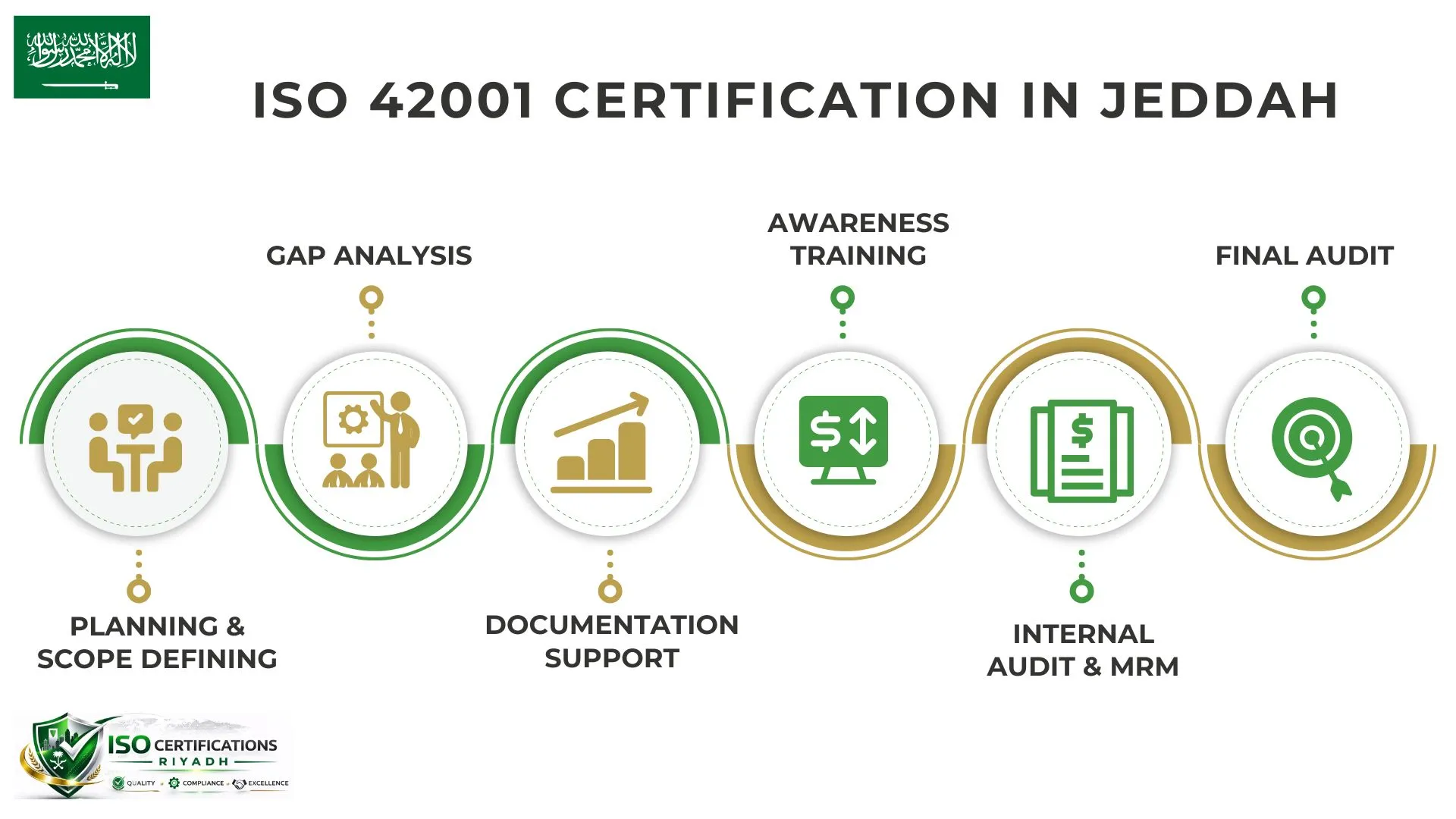
ISO 42001 Certification for Different Industries in Jeddah
Different industries use Artificial Intelligence differently and face different operational risks related to AI deployment. Because of this, ISO 42001 implementation should always align with the organization’s operational environment and AI exposure.
- AI Development & Machine Learning Companies: AI development companies and machine learning organizations in Jeddah often implement ISO 42001 certification to improve AI governance, strengthen monitoring visibility, improve risk management practices, and establish stronger operational accountability around AI systems.
- Data Annotation & AI Training Operations: Data annotation companies and AI training operations implement ISO 42001 to improve data governance practices, strengthen process consistency, improve monitoring visibility, and establish better oversight across AI training workflows.
- SaaS Platforms & Technology Providers: SaaS companies and technology providers increasingly implement ISO 42001 certification as AI-enabled features become integrated into customer platforms, automation systems, predictive analytics, and operational decision-making processes. The standard helps organizations improve governance visibility while strengthening operational trust.
- Healthcare & AI-Enabled Medical Operations: Healthcare technology providers and AI-enabled medical operations implement ISO 42001 to improve governance around AI-assisted decision-making, operational accountability, monitoring practices, and risk visibility across healthcare environments.
- Financial & Analytics Businesses: Financial technology companies, analytics providers, and data-driven organizations implement ISO 42001 certification to strengthen governance controls around AI-driven analytics, operational automation, customer data processing, and predictive decision-making systems.
Our Practical ISO 42001 Implementation Approach
At ISO Certifications Riyadh, our implementation approach focuses on building Artificial Intelligence Management Systems that are practical, operationally usable, and aligned with real business operations.
Instead of creating excessive governance documentation that teams rarely follow, we help organizations establish systems that improve AI visibility, strengthen operational accountability, and support long-term AI governance maturity.
- Gap Analysis & AI Governance Assessment
Every ISO 42001 implementation begins with understanding how the organization currently manages AI-related activities and operational responsibilities.
During this stage, we evaluate:
- AI-enabled operations
- machine learning workflows
- operational dependencies
- governance structures
- AI-related risks
- monitoring mechanisms
- customer expectations
- compliance obligations
The objective is to identify governance gaps and establish a realistic implementation roadmap aligned with the organization’s operational environment and AI exposure.
A structured AI governance assessment helps organizations focus implementation efforts on operational areas that genuinely require stronger controls and monitoring visibility.
- AI Documentation & Management System Development
Once implementation gaps are identified, we help organizations develop practical Artificial Intelligence Management System documentation aligned with operational activities.
This typically includes:
- AI governance policies
- operational procedures
- monitoring mechanisms
- risk management frameworks
- accountability structures
- escalation procedures
- operational controls
- compliance records
Our focus is not creating unnecessary paperwork. Instead, we establish systems that operational teams can realistically follow and management can monitor effectively across AI-enabled environments.
- System Implementation & Operational Awareness
Documentation alone does not improve AI governance unless the system becomes integrated into operational activities.
During implementation, we work closely with departments to integrate governance controls, monitoring activities, reporting structures, and accountability mechanisms into actual workflows.
Awareness sessions help teams understand:
- AI governance responsibilities
- operational controls
- risk monitoring practices
- escalation requirements
- accountability expectations
- monitoring obligations
This stage is critical because many AI governance failures occur due to weak operational oversight rather than purely technical issues.
A successful ISO 42001 implementation ensures responsible AI governance becomes part of operational culture rather than an isolated compliance exercise.
- Internal Audit & AI Governance Review
Internal audits are conducted to evaluate implementation effectiveness, identify governance gaps, assess operational controls, and review whether AI monitoring practices are functioning effectively across departments and AI-enabled activities.
Management review activities help leadership evaluate:
- AI governance effectiveness
- operational risks
- monitoring visibility
- customer concerns
- audit findings
- improvement opportunities
This stage improves operational visibility while strengthening governance accountability and audit readiness across AI-related activities.
Rather than treating internal audits as a checklist exercise, we focus on helping businesses use governance reviews as operational improvement tools.
- Certification Audit & Continual Improvement Support
Once the organization is prepared, the ISO 42001 certification audit process is coordinated with the certification body.
During this stage, we support organizations with:
- certification audit preparation
- audit coordination
- nonconformity closure support
- corrective action guidance
- continual improvement planning
However, certification should never be viewed as the final objective.
Organizations that gain the most value from ISO 42001 are usually those that continue improving AI governance practices after certification is completed.
Benefits of ISO 42001 Certification for Businesses in Jeddah
A properly implemented ISO 42001 Artificial Intelligence Management System provides operational and strategic value beyond certification itself.
- Improved AI Governance Visibility: ISO 42001 helps organizations establish structured monitoring practices that improve visibility into AI-related risks, governance responsibilities, operational controls, and monitoring obligations.
- Better Customer & Enterprise Client Confidence: Enterprise customers increasingly prefer working with organizations that demonstrate responsible AI governance and structured operational oversight around AI-enabled activities. ISO 42001 certification strengthens credibility during enterprise onboarding, AI governance assessments, outsourcing partnerships, and customer evaluations.
- Stronger Operational Accountability: Organizations implementing ISO 42001 often improve accountability structures, governance responsibilities, operational visibility, and oversight across AI-driven processes and automation workflows.
- Improved Risk Monitoring & Operational Oversight: A structured Artificial Intelligence Management System helps organizations identify governance gaps earlier, strengthen monitoring controls, improve escalation visibility, and reduce unmanaged AI-related operational risks.
- Better Long-Term AI Governance Maturity: ISO 42001 helps businesses establish more sustainable AI governance frameworks that support operational scalability, customer trust, and long-term responsible AI adoption.
- Reduced AI-Related Operational Risks: As organizations become increasingly dependent on AI systems, ISO 42001 helps improve governance visibility and reduce operational risks associated with uncontrolled AI deployment and weak monitoring practices.
Cost Of ISO 42001 Certification In Jeddah?
The cost of ISO 42001 certification in Jeddah depends on several factors, including the size of the organization, number of employees, complexity of AI systems, and the level of AI-related risks involved. Organizations that use advanced artificial intelligence technologies or manage large volumes of data may require more detailed assessments and controls, which can influence the overall certification cost.
The total investment typically includes consultancy services, AI risk assessments, documentation development, employee training, internal audits, and certification audit fees. Additional costs may arise if businesses need to establish new AI governance frameworks or strengthen existing AI management practices before certification.
Why Businesses Choose ISO Certifications Riyadh for ISO 42001 Certification in Jeddah
Organizations across Saudi Arabia choose ISO Certifications Riyadh because our consulting approach focuses on practical AI governance rather than generic compliance templates.
We understand that AI governance challenges vary significantly between AI development companies, SaaS platforms, healthcare technology providers, analytics businesses, automation operations, and data-driven organizations.
Because of this, our ISO 42001 consulting approach focuses on:
- practical governance controls
- operational integration
- AI risk visibility
- accountability structures
- monitoring mechanisms
- audit readiness
- continual improvement
- operational usability
Rather than creating systems that exist only for certification audits, we help organizations establish Artificial Intelligence Management Systems that support real operational governance and long-term AI accountability.
Start Your ISO Certification in Riyadh Today
Get expert guidance, fast approval, and internationally recognized ISO certification for your business in Saudi Arabia.
FAQs
What is the purpose of ISO 42001 certification?
ISO 42001 helps organizations establish a structured Artificial Intelligence Management System focused on responsible AI governance, operational accountability, risk management, monitoring controls, and continual improvement.
Which industries commonly implement ISO 42001 in Saudi Arabia?
ISO 42001 is increasingly implemented across AI development companies, SaaS businesses, healthcare technology providers, analytics companies, BPO operations, automation-focused organizations, and data-driven enterprises.
Is ISO 42001 certification mandatory in Saudi Arabia?
ISO 42001 certification is generally voluntary, but many enterprise customers, technology partnerships, outsourcing contracts, and multinational organizations increasingly prefer businesses with structured AI governance frameworks.
How long does the ISO 42001 certification process take?
Implementation timelines depend on organization size, operational complexity, AI exposure, governance maturity, number of AI-enabled processes, and existing operational controls.
Do you provide ISO 42001 consulting services across Saudi Arabia?
Yes. We provide ISO 42001 consulting, AI Management System implementation support, governance documentation development, internal audits, awareness training, and certification preparation services across Jeddah and throughout Saudi Arabia.